Showing posts with label bad managers. Show all posts

Thursday, August 1, 2013

Make sure your managers know the law, and their people!

Read this article to see why....

Supreme Court Redefines Supervisor in Discrimination Case
  
In June, the Supreme Court issued a ruling that made it harder for workers to prove they had been a victim to employment discrimination. The first ruling narrows the definition of what classifies a supervisor, thus leaving plaintiffs with a different burden of proof. In Vance vs. Ball State University, Maetta Vance – an African American worker, accused her supervisor Saundra Davis –who is white and described as a catering specialist, of racial harassment claiming that Davis had glared at her, slammed pots and pans, and blocked her on an elevator. However, both sides agreed that Ms. Davis did not have the authority to hire or fire employees.

Justice Samuel A. Alito Jr. rejected the EEOC’s definition of a supervisor and ruled that “being a supervisor should be limited to someone authorized to take ‘tangible employment actions’ like hiring, firing, promoting, demoting, or reassigning employees to significantly different responsibilities,” according to the New York Times. This ruling specifies that an employer could not be held liable in a co-worker to co-worker claim unless it can be proven that the employer failed to exercise reasonable care to prevent or correct any harassing behavior.

Employers should be aware of this ruling that clearly defines the difference between co-workers and supervisors. The employer’s liability is greatly increased if a supervisor is accused of employee harassment or discrimination. Therefore, companies should be aware of the EEOC and OFCCP compliance regulations that they are required to adhere to.

Innovative Leadership can help your company in various ways! Contact us to find out how http://www.innovativeleadershipdv.com


Wednesday, April 18, 2012

Do employees really leave because of bad managers?

The reasons that employers score poorly are varied and many:

  • 39% of workers said their supervisor failed to keep promises

  • 37% indicated their supervisor failed to give credit when due

  • 31% said their supervisor gave them the "silent treatment" during the past year

  • 27% report their supervisor made negative comments about them to other employees or managers

  • 24% indicated their boss invaded their privacy

  • 23% said their supervisor blamed other to cover up personal mistakes or minimize Linkembarrassment

Read Full Florida State University Study Here

So, now what? Innovative Leadership of the Delaware Valley helps build stronger businesses, one employee at a time. With our Making of an Effective Manager, we teach managers with real life situations, blended learning built for adults and classroom interaction with peers and facilitators with over 30 years experience. Click here for more info

Thursday, September 10, 2009

When will we understand?

I conducted an informal survey and found that most managers do not understand what their most important function is at work. Most managers feel that their most important function is to provide revenue, reduce costs or maintain margins. They do not realize that those things come from the results being produced by the organization through its people and processes not through anything else. Those metrics usually reflect the effectiveness of the organization.

So what makes an organization effective? Plain and simple; when a company focuses on it’s people and there is enhanced performance and improved productivity. In an article that I recently read, it was noted that in the software development industry, turnover rates approached 20%. Yet one company is that industry exhibited less than a 5% turnover! Imagine the savings to the company in terms of time saved in recruiting, training, and just plain managing.

We continue to find that middle management is most important ingredient to preserve good to great employees. First, an employee’s boss is the company to them and they will leave if they don’t receive positive feedback from the boss. Secondly, positive feedback must be timely. Most managers don’t realize that their role must be focused on their people and their performance is a direct reflection of their people’s success. People need to be engaged and if they aren’t engaged, they move on to another job. People will not stay in a job where engagement is not fulfilled, period. So what are you doing about it?

Your primary role as a manager is the development of your people. The CEO, President, HR Professional, and any decision maker in the company must realize that management training is the most important ingredient they can provide because the managers’ tasks revolve around making sure their people are well served and they understand the value of their work. If you don’t have an engaged workforce, then you have a workforce with their eyes on the door. Most managers do not exhibit good interpersonal skills with their staff but companies still are not responding to their training needs.

Please forward this article to back up the need for training.

Wednesday, August 6, 2008

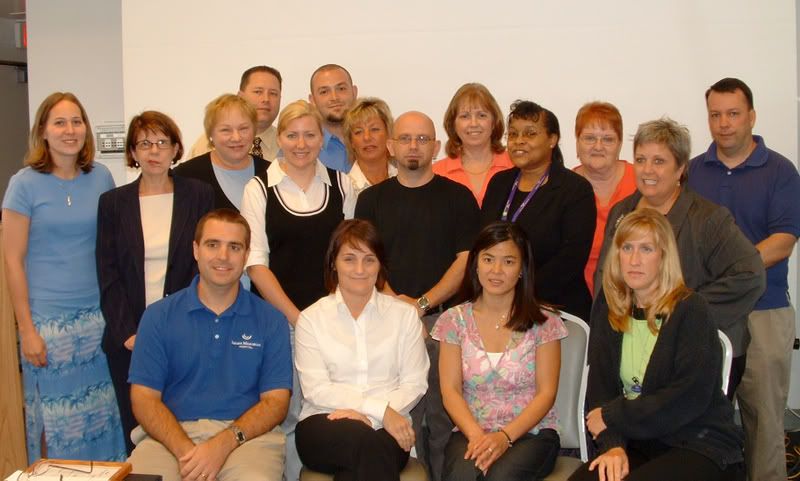
Shore Memorial Graduates


Congratulations to the Shore Memorial Graduates of our Making of an Effective Manager Course. In alphabetical order: Laurie Bartine, Jody Brady, Jon Cuviello, Sharon Dougherty, Michael Fox, Cheryl Franks, John Gosner, Anna Marie Guerrieri, Susan Krantz, Ken Michelette, Diane Miller, Denise Minus, Pam Mood, Sean Mulligan, and Karen Renzulli

The next Public Making of an Effective Manager Course starts September 17th at our Marmora Training Room. Managers will gain confidence to make the right decisions and will know how to motivate and retain employees. Don't forget this counts as continuing education credits!
More Information

We hope to see you and your managers there!

Tuesday, November 13, 2007

Don't Show Bias in Employee Reviews

I was reading a lead article titled, “Bias Found in Employee Appraisals” found online at www, hreonline.com. It was an article that elaborated on the fact that new research shows vast discrepancies in employee appraisals by workers who report to two bosses.

I am not being critical of the author, but in what work environment would that not present itself? Performance Appraisals have always shown bias from one manager to another. Many consulting firms recommend that companies not spend money on the training and development of their managers regarding the delivery of an employee appraisal by a manager. If we don’t train to develop consistency in delivery, then how can we ever have a Performance Appraisal System without bias?

I am a firm supporter of Performance Management and the availability of a sound Performance Appraisal Process that is conducted quarterly in terms of reviewing the progress of the individual’s development plan. It is time that managers realize that the Performance Appraisal Process is the best means to communicate workplace expectations with the employee and that employee engagement is the key to retention moving forward. Managers must utilize a system for monitoring performance on a day to day, month to month basis and not just wait for the annual performance appraisal process for the data to appear. A Performance Log or file must be maintained throughout the year to note successes, learning opportunities, behavioral tendencies, etc. The Performance Appraisal Process must be more objective than subjective and certainly results-oriented. It must be based on the job description or role assigned to the employee as the role is defined today, not five years ago. It must reflect technical skills as well as performance skills that demonstrate an above average performance in that position. Above average performance should be the workplace expectation of most managers. Clear expectations must be defined. Clarity and good communication are key management skills for this to succeed. We must communicate workplace expectations in a clear, decisive, and definitive manner with the creation of a development plan for the employee. All managers must be willing to coach and mentor the employee to high performance through the use of a solid Developmental Plan of Action. I have always believed that the formulation of a developmental plan for a high achiever is one of the most difficult tasks a manager can undertake. And it certainly shouldn't be….it should be the opposite.

Both bias and the dreaded “Performance Appraisal” mentality must be eliminated from the equation….discuss expectations, monitor performance daily, and make employee engagement a priority. If you do that, the bias and subjectivity will be removed.

Wednesday, September 5, 2007

Can We Change the Environment?

It was noted in an article I recently read by Scott Flander titled, “When bosses go bad and get rewarded”, which appeared on www.hreonline.com that at a recent Management Meeting in Philadelphia, it was noted that in over 45% of the cases, employees noted that offensive bosses got promoted instead of “canned”. In over 19% of the cases, nothing happened to the incompetent boss. I chuckled hilariously when it was noted by John Hoover, author of How to Work for an Idiot: Survive and Thrive Without Killing Your Boss, that “the more incompetent someone is, the faster their career takes off”.

My theory is when we have a glutton of bad managers; we certainly have a great number of bad interviewers. In other words, we already have a glutton of bad managers who do not have the skills to change the culture. I honestly feel that companies need to focus on their interviewing process first, and then try to develop their management team second. I find that very few companies are using assessment tools in either the hiring and selection process or their people development process. I hear comments like, the boss does not like assessments, or we can’t open ourselves up to potential employee relations liability. I also find that they don’t have an interviewing process in place and most interviews for key positions are “winged”. I also hear that the company does not have a succession plan or even a pathway for employee development. No one, including anyone on the senior management team or in HR is focused on anything but the “bottom line”. Who cares about our people, are we profitable? No one is defining the metrics needed to improve the situation so what else can we expect but “bad managers”.

Suddenly a “red” light goes off and HR or Management now realizes that their managers really are not exhibiting the skills and competencies needed to take their company to the next level. The good people are leaving and the retention of talent is becoming a real concern……

So I ask, why are not we pulling out all the stops in talent acquisition and retention….or is it that we just want to wait until we get enough bad managers to warrant the need for training……

I think that if we look at talent acquisition and retention as a process and implement training from their orientation period, we might find ourselves focusing on the real leaders of the future.