Showing posts with label high achievers. Show all posts

Thursday, July 9, 2009

SUPREME COURT DECISION FAVORS TESTING

By Richard Hohmann Redeem 2 Free Assessments from Innovative Leadership

On Monday June 29, 2009, The Supreme Court in a 5-4 decision ruling favored white and Hispanic fire fighters advancing the case for validated testing and assessments in the workplace in America.

In 2003 Lt. Ben Vargas was one of 56 New Haven, Conn. Fireman who passed the test for promotion to Captain of whom 15 were black or Hispanic. When the city discovered that only two out of the 56 were likely to be immediately promoted (due to lack of job openings) the city threw out the test for fear of being sued by minority candidates who might allege discrimination.

However, 17 white firefighters plus Vargas (a total of 18 firefighters) filed suit against the city for throwing out the test. The Supreme Court has now ruled in behalf of the 18 who filed suit against the city for throwing out the test . This ruling delivered the message that rejecting employment test results because of the lack of minority candidates eligible for promotion violates Title VII of the Civil Rights Act of 1964.

Justice Anthony M. Kennedy wrote for the majority, “Fear of Litigation alone cannot justify an employer’s reliance on race to the detriment of individuals who passed the examinations and qualified for promotions.”

The 18 plaintiffs in the case studied intensively for the test, giving up second jobs and missing family celebrations. The lead plaintiff, Frank Ricci was dyslexic and had studied 8 to 13 hours a day, and had hired an acquaintance to tape-record the study materials for him.

In the case before the court, Ricci v. Stephano, No. 07-1428, the majority said there is no evidence, let alone strong evidence, of any problem with the tests. With this ruling, the Supreme Court has in reality sent a variety of messages to employers in both the public and private sector:

When using a validated job related test that has proven to be nonbiased by race and sex
that test or assessment may legally discriminate against minority groups who do not have the qualifications for the job. In this case black fireman who took the test failed to learn the necessary material to pass the test.

Would we allow Doctors to practice medicine who do not pass the medical exam? Lawyers who don’t pass the bar exam to practice law? or CPA’s who haven’t passed the CPA exam to offer their services as a CPA---Obviously the answer “NO”. Employers have the right to require people to be qualified for the jobs they are hiring them for or promoting them into and the Supreme Court has just upheld that right.

In this case the Supreme Court sent a clear message that being in a minority group who failed a validated job related test is not an acceptable basis to file a discrimination complaint.

The Supreme Court Decision further sent a message to employers that job related validated tests and assessments are usable and defensible in both the hiring and promotional processes and are clearly some of the most validateable parts of an employers hiring or promotional process as a result of the clear cut rules established for validation in the Uniform Employment Guidelines published in the Federal Register in 1979.

This Supreme Court Decision is a job win for companies like Innovative Leadership and its Achiever Series of Assessment Instruments. (www.ILDV.org), The Achiever Series are job related assessments that has been repeatedly proven to be validated and nondiscriminatory by race, color or sex which does identify individuals who do not fit the requirements of the job. The Achiever is now America’s premier job-related assessment instrument for use in both applicant selection and people development processes. There as never been an adverse finding, or settlement out of court, against any employer for its usage. Information on the validation of the Achiever and validation of tests and assessments in general and their optimum usage is available at www.whytest.biz.

Please call for more information on America’s Premier Assessment Instruments distributed by Innovative Leadership at 609.390.2830 or contact us here: http://www.innovativeleadershipdv.com/contact.asp

Richard Hohmann is the senior consultant/Vice President for Innovative Leadership of the Delaware Valley, LLC. He is a graduate of the Ohio State University and has over thirty years of Leadership and Management Development experience. His focus is on the effectiveness of the organization and the development of their people to enhance performance and improve productivity. He teaches managers and leaders to know what it takes to be successful and then uses a defined plan to teach them how to do it until they succeed. He has written numerous articles for national publications and speaks at many association meetings nationwide. He is very involved with his community organizations and professional affiliations.

Wednesday, September 17, 2008

Leadership Doesn't Just Happen: Lead by Intention

When people compliment your success, do you talk about luck rather than purpose? Maybe you should remember chemist Louis Pastuer's assertion that "chance favors the prepared mind." People don't rise to the top by accident. It takes intention to become a great leader. Here are some secrets that can help you out in front:


  • Broaden Your Mind. Management consultant Peter Drucker studies a new subject each summer randing from science in Acient Chine to Russian literature. Inspire out-of-the-box thinking and recapture the joy of learning by takinga class in an off-the-wall subject.

  • Toot Your Horn. You don't need to become a braggart but you do need to be able to describe your strengths to others who might help further your career. Review your training and experience and pick out the traits you feel are most valuable. You'll find it easier to get the hang of touting your attributes without embarrassment if you practice describing them as if you were talking about a third person.

  • Make a Stretch. Rather than waiting for opportunity to knock, ask your supervisor what you should do to prepare for a job two grades above your current position. Be honest in explaining that you're ambitious and want to build skills for a long-range future.

  • Face the Music. You'll never be a strong leader until you conquer the fear of giving presentations. Take a public speaking course or join a local Toastmasters chapter. Once you get into the habit of speaking in a non-threatening environment, it will be easier to take the stage when it really counts.

  • Find an Example. Look for leadership models in your company, your industry, in public life - or even in works of fiction. Learn all you can about these individuals and emulate their styles or incorporate some of their strong traits into your own style. After all, it's easier to lead if others think you fit the part.

  • Take a Chance. Find projects that will take you out of your comfort zone. As First Lady Eleanor Roosevelt once said, "You must do the things you think you can not do."

- Adapted from "7 Ways to Lead," by Harriet Rubin

Monday, August 25, 2008

Middle Managers are the Implementers

Today, I sat in a management meeting observing the dynamics of the meeting and watching the body language of the participants for an hour and a half. It is important when I am coaching executives that I observe the environments that can make a difference. It became evident that most of the managers in that meeting have not been told how their performance brings value to the organization and as a result they rarely pass on the value message to their employees. Employee appreciation is not new but understanding the value to the organization may be new to some. Concerns about communication, accountability, responsibility, and collaboration were expressed in one form of another by almost everyone around the table. The facilitator was particularly good today with his fairness and recognition of the other manager’s contributions to the overall success of the organization but I left with the feeling that his hands were tied in terms of getting the desired results.

It was important for all of them to realize that communication is a key element in getting people to understand what they can do to contribute to the success of the organization. At this meeting, there could have been more concrete objectives, more story-telling, more real-life examples, etc. but the defined need was to take responsibility for taking action. A commitment to take an action that may change this environment to a more positive experience.

I now know why there is no question why we call them middle managers. Middle management needs to listen to the senior or executive leadership team and while being responsive to the rest of the employees. As we know this listening and implementing position, AKA middle management, has always been the buffer between the top and the bottom. This is why middle management is often called the “glue” that binds the top to the bottom, much like an Oreo cookie.

It is my opinion that middle management is the one component that cannot be overlooked. Unfortunately, companies continue to put these positions in jeopardy when the economic climate turns cold. Middle managers continue to be the implementers of the strategy and policy. Middle managers are the change initiators. If change is not managed well, it has been shown that employee engagement never happens and low morale starts rearing its ugly head. It is my opinion that when external factors become evident and competition gets more aggressive, it is time to focus on the middle management and make sure that we are meeting their needs. Remember, middle management is the layer that attracts, retains, and develops top performers. Let’s not let the normal knee-jerk reaction occur when times get tough. Let’s focus on what we can do to develop our middle management team and allow them to implement the changes needed to satisfy the strategic direction of the company. Let’s give them the tools to do the job right and those tools involve training, career opportunities, feedback and recognition.


Don’t just eliminate the tools that help develop people, like training, education, and incentives.
When looking for training for your middle managers keep these points in mind:
Focus on programs and processes that guarantee results.
Use programs and processes that are time-tested, research-based, and results-oriented.
Use programs that that focus on the adult worker and are designed to change behavior, not just focus on behavior.
Make sure that measuring results is part of the plan.

It is estimated that 20% of all new hires will either rise to the top or fall to the bottom and remaining 60% will be productive and be engaged but only if your middle management team is committed to their success. Their achievement can make the difference with both performance and productivity and it must be acknowledged and recognized by their manager. Providing the tools and career path for people to achieve is what makes the difference between a good employee staying or walking out the door.

Innovative Leadership has a public course, open for enrollment, starting September 17, 2008 from 3-5pm. Click Here for more information

Wednesday, August 6, 2008

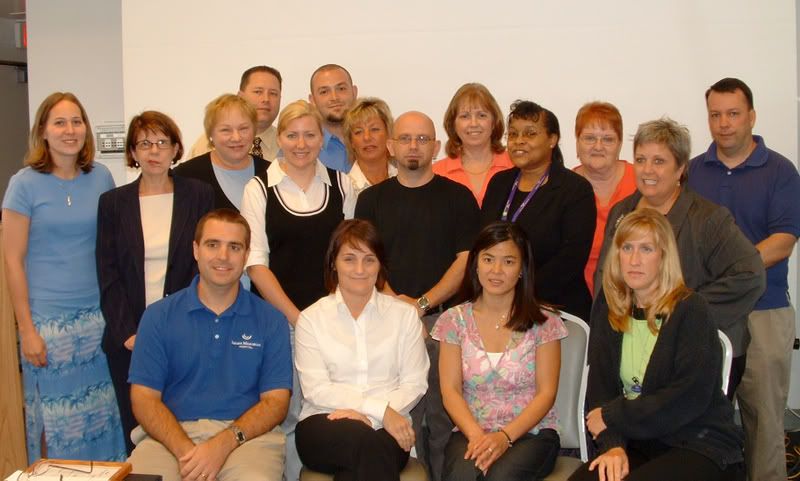
Shore Memorial Graduates


Congratulations to the Shore Memorial Graduates of our Making of an Effective Manager Course. In alphabetical order: Laurie Bartine, Jody Brady, Jon Cuviello, Sharon Dougherty, Michael Fox, Cheryl Franks, John Gosner, Anna Marie Guerrieri, Susan Krantz, Ken Michelette, Diane Miller, Denise Minus, Pam Mood, Sean Mulligan, and Karen Renzulli

The next Public Making of an Effective Manager Course starts September 17th at our Marmora Training Room. Managers will gain confidence to make the right decisions and will know how to motivate and retain employees. Don't forget this counts as continuing education credits!
More Information

We hope to see you and your managers there!

Monday, June 9, 2008

Chewing Gum and Band-aids

I just received the Chamber of Commerce Southern New Jersey’s Board Council’s on Responsible Government Report – Phase III – Meeting the Challenge: Saving Taxpayer Dollars by Adopting Best Practices”. The publication pointed out the differences between the Private Sector Practices and that of State Government followed by recommendations to the State for improvement by implementing these best practices.

This publication focused on the following: Job Classification Systems, Hiring Practices, Employee Assessment & Pay for Job Performance, Professional Development, Disciplinary policies, Human Resources and Personnel Management.

This is not a political commentary but when hasn’t the private sector had to focus on hiring and selection, retention, performance management and people development. What I questions, is, “How many companies in the Private Sector do anything more than acknowledge the need or focus on the concern?" Most companies today are aware of the employment statistics facing us today and many have moved on to the planning stage and have started to develop Succession Plans, Behavioral Interviewing Scorecard, utilization of an Assessment Process, implementing some type of “three strike rule”, retention of Key Employees or Top Producers, and a Career Management program.

I still would bet that those same companies have not implemented formalized plans or more importantly, designed processes to compliment the needs and focus of the company. Band-aids and chewing gum are being used to cover the gaps created by the “good to great” employees that are bailing something better or we are doing everything in our power to keep the baby boomers from jumping ship. I really feel that this “quick fix” mentality will not hold for long.

We are loosing a talented management pool that we are not training and developing at a speed equal to that of the exodus from the workforce by the baby boomers. We will find ourselves with a inexperienced, non-communicative, non-inspirational management team that can only lead by example because they will not have the skills to move the workforce upward and onward. They will have to be task-masters to gain the knowledge that the exiting management team declined to share.

There is only one Best Practice out there that satisfies the needs of any company in the areas of productivity, performance, and passion. It can eliminate the worry about employee engagement or motivation and it can provide the foundation for performance management. The Best Practice that needs to be embellished by both the private and public sector is to spend the time and money on your middle management. In simplest of terms, train the immediate supervisor because he or she is the one that is going to make the difference in hiring and selection, personnel development, performance management, positive discipline, and more.


The ROI for the training and development of your management team will easily be satisfied when you look at turnover, key employee retention, knowledge sharing, cross training, and behavior in the workplace.

Tuesday, May 27, 2008

Talent Management Means Competent Leadership

Talent Management is an entity that has been slowly evolving within many corporations. Most corporations list the following practices as part of their overall program:

  • High potential employee development
  • Leadership Development
  • Professional Development
  • Succession Planning
  • Career Planning
  • Learning and Training
  • Performance Management
  • Competency Management
  • Retention
  • Employee Engagement


Talent Management should concern itself with competencies. Companies should focus on the competencies that make a difference today and will continue to make a difference tomorrow. It means fitting the “right person” to the “right job” and then measuring their impact on the company’s strategy or goals.

In simplest of terms, Talent Management is people development associated with organizational effectiveness. Most companies do not have a clue about what Talent Management means to them and what competencies will provide sustained growth and success. It is important that they focus on their Strategic Development plan now and don’t wait until it is too late. It will be too late when they do not have the people who are able to learn and perform the roles and responsibilities needed for sustained growth. Do we have the people that can respond to the rapidly changing, highly competitive marketplace?

Most companies have not yet assessed the talent within their organization. How can the learning and training components be applied when you don’t know what is needed to develop the people. People are starting to talk about succession planning only because a lot of key people are leaving the workforce for retirement or alternative careers. I joined a pharmaceutical company in the late sixties and within three weeks, the company has decided that I was a “High Potential”….an HP as we called it back then.

A fast track of combined learning and training programs were laid out before me while at the same time, my performance was monitored as if I was under the microscope. It appears that many companies have strayed away from labeling “high potentials” and providing a program to accelerate their careers within the company. Now, I know some companies have accelerated programs and call these designated potential leaders something, like top producers, achievers, or whatever.

It just seems like the same old story. We have been concerned about this problem for many, many years but we have done nothing to provide a fully integrated set of human resource functions that can be called a people development process. We hesitate to assess anyone or anything because it will cause conflict and we can’t have conflict when we need to retain good talent.

Is Talent Management really meeting the needs of most companies? What are we waiting for? The leadership of our companies must step up and focus on a Strategic Development Plan that includes people, processes, and performance. The integration of those three entities often results in employee engagement, motivation, and success.

Human Resources in many companies is defined as the human capital experts. So, when are these so-called experts going to jump up and down and give their leadership team a real assessment of the culture, the people, and the potential to more forward while sustaining growth and reaching goals? It will probably be when all the Talent has left.

Wednesday, January 23, 2008

The Weather Outside is Frightful!

Don’t let this holiday song provide a foundation theme for 2008! You certainly can tell it is winter by the methodology being used by the weather forecasters to panic the local residents into spending hours at the grocery store buying all the necessities for a mid 1950’s blizzard. I sit there listening to them tell me that the potential for the front moving rapidly from the South up the coast colliding with the Arctic air being driven down by a Canadian high located over some Lake near Michigan should produce a tremendous snowstorm that supposedly we have all been waiting for. I wake up the next morning and I find a “dusting” if anything but the result of the forecast is that WAWA has sold more milk and bread compared to previous snow storm announcements (for those not in the Philadelphia market, WAWA is the leading convenience store where you buy milk and bread) We are starting to hear the same thing about a global recession. After conducting their annual S.W.O.T., it has now become part of everyone’s strategic plan to list an economic recession as the major external threat that may affect their business success for the upcoming year. I guess we better get in line at your local WAWA to buy cost reduction measures, recession-proof armor, revenue producing fairy dust, and more. Unfortunately, I can feel the cost-cutting measures starting to unfold as I am writing this article.

There is no question that the economy may more than likely turn “chilly” in the upcoming year and the predictions for the real estate market continue to appear “frigid”. Forecasters are predicting that there is a heightened interest in career development and paying down personal debt. Business leaders have learned in 2007 that employee loyalty is waning as employer commitment begins to weaken. The generational shift in ownership in small businesses and the retirement rush is the corporate environment has begun and will accelerate in 2008. Economic trends are being characterized by shorter job tenures, changing generational values, scarce talent, and a surplus of vacant positions.
Statistically it is well documented that these trends are real. These trends are affecting all levels within an organization and we need to focus on the acquisition of talent, identification and development of leaders within an organization, and the retention of good employees. Survey after survey demonstrates that most businesses believe there is a current shortage of quality leadership talent in the workforce and they measure personality or behavioral styles when identifying future leaders. It is also well documented that most companies have not implemented an adequate leadership development plan and not focused on the emotional intelligence of the future leader.
The real concern for me is that most companies still do not realize that their people offer them the most competitive advantage in any economic climate.
First, it is important that you do not let the business weatherpersons scare you into a cost-cutting frenzy in that areas of business that means the most to your employees. Second, leadership and career development cannot be achieved without an effective training and development process. Not a program, but a process! I ask you to be innovative in the selection of your tools and products for this process and of course, make sure they are cost – effective but most importantly, produce the desired results or behavioral change that your company needs to be more competitive in 2008. Don’t let the forecasters scare you into cutting the processes that will mean the difference for your future.


Innovative Leadership offers training and development for all levels of your employees. Executive Coaching, Manager Training, and even Customer Service. Get more competitive and make a difference with these programs and processes. Contact us to get started today!

Tuesday, November 13, 2007

Don't Show Bias in Employee Reviews

I was reading a lead article titled, “Bias Found in Employee Appraisals” found online at www, hreonline.com. It was an article that elaborated on the fact that new research shows vast discrepancies in employee appraisals by workers who report to two bosses.

I am not being critical of the author, but in what work environment would that not present itself? Performance Appraisals have always shown bias from one manager to another. Many consulting firms recommend that companies not spend money on the training and development of their managers regarding the delivery of an employee appraisal by a manager. If we don’t train to develop consistency in delivery, then how can we ever have a Performance Appraisal System without bias?

I am a firm supporter of Performance Management and the availability of a sound Performance Appraisal Process that is conducted quarterly in terms of reviewing the progress of the individual’s development plan. It is time that managers realize that the Performance Appraisal Process is the best means to communicate workplace expectations with the employee and that employee engagement is the key to retention moving forward. Managers must utilize a system for monitoring performance on a day to day, month to month basis and not just wait for the annual performance appraisal process for the data to appear. A Performance Log or file must be maintained throughout the year to note successes, learning opportunities, behavioral tendencies, etc. The Performance Appraisal Process must be more objective than subjective and certainly results-oriented. It must be based on the job description or role assigned to the employee as the role is defined today, not five years ago. It must reflect technical skills as well as performance skills that demonstrate an above average performance in that position. Above average performance should be the workplace expectation of most managers. Clear expectations must be defined. Clarity and good communication are key management skills for this to succeed. We must communicate workplace expectations in a clear, decisive, and definitive manner with the creation of a development plan for the employee. All managers must be willing to coach and mentor the employee to high performance through the use of a solid Developmental Plan of Action. I have always believed that the formulation of a developmental plan for a high achiever is one of the most difficult tasks a manager can undertake. And it certainly shouldn't be….it should be the opposite.

Both bias and the dreaded “Performance Appraisal” mentality must be eliminated from the equation….discuss expectations, monitor performance daily, and make employee engagement a priority. If you do that, the bias and subjectivity will be removed.