It seems like the HR professional must continue the fight for training and development since it does not appear that the CEO has realized the value of training to the company or organization.
Companies focus on profits, stock prices, and performance, but not on employees. How do we forget to see the value in our people, particularly our key employees, when it comes to celebrating our business outcomes? Studies have shown that companies that invest more heavily in training and development have been more successful in achieving their defined outcomes.
Many of the recent studies have concluded that a more engaged workforce provides enhanced performance and improved productivity. Companies with a more engaged workforce seldom have morale issues. “In the 21st century, our natural resource is our people – and their potential is untapped and vast. Skills will unlock that potential.” (Leitch Review, December 2006) Even with the economic climate of the past year or two, it has been demonstrated that training expenditures were a strong predictor of stock prices.
So where is the hidden agenda? Is any CEO really interested in the productivity and developing the potential of their people or is the real objective of only reducing cost associated with people including the people themselves. I have seen a decrease in revenue of less than 10%, yet the company has reduced its labor forces by almost 30%.
Training the management of any organization will certainly prove to make the organization more effective. People are looking for advancement and an opportunity to develop skills to assist with their upward mobility. They want feedback immediately from their supervisor and they want to work in an environment that supports their development. The social culture that is presented today by companies is very important to the millennial generation. Many believe that a budget for employee development indicates whether a company is in it for the long haul or not.
If we expect to retain our top producers in the management positions, we better make sure that they have the skills and competencies to work with four generations of workers. This ensures that knowledge is shared, cross-training is completed and the work is getting done in a timely fashion. We need to teach our management team that communication is the key to people success and that success can only be achieved if we develop people’s potential and focus on productivity and performance, and not just trying to reduce costs. Reducing training budgets can be detrimental.
We are fortunate that the economy has kept the Baby Boomers in the workforce but how long will that last? It looks like we will be left with an untrained workforce that doesn’t like to communicate with others. It sure sounds like it might not be the best time to be in a management position.
Come on Mr. CEO; listen to your People Developer. Investing in your management team will produce an improved bottom line. If you don’t believe that training and development can affect the bottom line, just look at how the reduction in their training budget prepared Wachovia for the merger with Wells Fargo. Their training budget was reduced by over 50% and their stock fell as much as 95% before the bank finally agreed to the merge. Helping people reach their potential, coupled with effective processes and procedures can certainly affect the effectiveness of the organization.
The time to train is now and please pass this on to the decision makers in your company!
Showing posts with label development of people. Show all posts
Showing posts with label development of people. Show all posts
Friday, October 23, 2009


Monday, August 17, 2009
The Art of Delegation
According to most management publications, the primary responsibility of the manager is to get work done through other people. Too many times, the art of delegation is not looked upon as a most positive experience. It is considered “dumping” by many, and the reason for this attitude by the employee is the method in which the delegated assignment is presented. As a good chef would say, “it is all in the presentation”. In other words, the key to delegation is communication and training.
Practicing effective delegation is what makes delegation an art as opposed to a science. It is the most important if not the most effective technique for getting work done through other people. Hence the definition of effective delegation is the act of giving someone else the responsibility and authority to carry out an assignment or to represent you or your organization in a specific role. Some people expand the definition to include the sharing of responsibilities with others in the company where it is appropriate and logical.
It is important that you, the manager, has the right attitude in delegating. You must be willing to spend the time training people. You must remove the fear that often presents itself when you train someone to do exactly what you do. The fear that you will be replaced.
The truth is that effective delegation leads to opportunities for you, as well as your people. Most managers fail to monitor delegation because they don’t realize the importance of delegation in terms of the development of their people. The employee is anxiously awaiting direction, and if needed, additional training. People want to feel empowered and delegating brings you an excellent opportunity to do just that! It is important that you make feedback specific to behavior. You must make sure that the person to whom you are delegating takes ownership in terms of accountability and responsibility. Effective leadership generates productivity. The development of your staff can bring pain as well as joy. Delegation is one of the most valuable instruments to help initiate change.
Delegation is a skill that needs to be learned and developed. Most inexperienced managers have the most difficulty in mastering delegation skills. Be patient and as Vince Lombardi says, “Practice. . .Practice. . .Practice!” Success runs on empowerment of people, and empowerment runs on delegation. Looks like it's time to start delegating!
Wednesday, April 8, 2009
Evaluate Talent from Day One
Where is Your Focus? on Your People or on Your Process?
In a recent article in the Investor’s Business Daily, Kevin Harlin points out that Employment consulting firms say it is vital to track and nurture promising leadership candidates even though the economy is sluggish. Steve Krupp, partner and leader of the executive talent management practice at Delta Organization & Leadership, asserts that if a company fails to engage and communicate its top performers, they might be inclined to depart.
Rather than focusing on your processes, focus on your people. They are your biggest asset. Remember that turnover can cost you double of just one employee’s salary. A survey from Delta found that most U.S. companies fail to monitor their best performers, even fewer communicate with these employees, and few top executives support such initiatives.
PPG Industries, a global glass, paint, and chemical firm, has been tracking its best employees for about a decade. Roughly 30 percent of workers are regarded as top talent, and just 1 percent is deemed suitable for the CEO position. Identified employees get first priority for training, special projects, and responsibilities. Executives also meet with these employees from time to time at informal settings like breakfast or lunch. Global business software firm SAP provides potential leaders with six-month fellowships in another division, typically in a different location, to ensure that these employees have adequate insight into the company.
The above synopsis of the article that appeared in Investor’s Business Daily demonstrates the need to evaluate talent from the first day of hire in terms of recognizing potential and people development as the priority for any organization. I really question whether companies today are focused on their future leadership and understand the need to develop people’s potential.
Innovative Leadership offers an Assessment Process called the Achiever Series that can assist you with people development and also compliment certain aspects of succession planning, downsizing or transformation.
We are a company that is focused on helping companies develop their potential of their people that will result in organizational effectiveness. Please call us at your convenience to discuss our Assessment Processes that can make the difference in the future of your company at 609.390.2830.
Wednesday, August 6, 2008
Shore Memorial Graduates
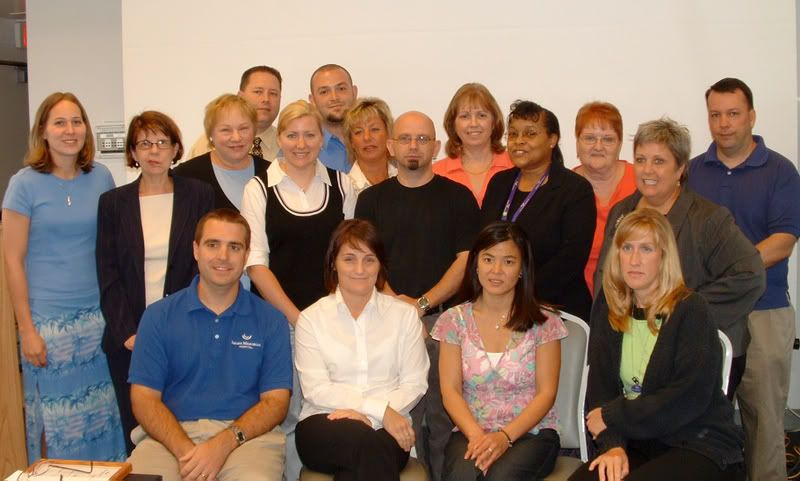
Congratulations to the Shore Memorial Graduates of our Making of an Effective Manager Course. In alphabetical order: Laurie Bartine, Jody Brady, Jon Cuviello, Sharon Dougherty, Michael Fox, Cheryl Franks, John Gosner, Anna Marie Guerrieri, Susan Krantz, Ken Michelette, Diane Miller, Denise Minus, Pam Mood, Sean Mulligan, and Karen Renzulli
The next Public Making of an Effective Manager Course starts September 17th at our Marmora Training Room. Managers will gain confidence to make the right decisions and will know how to motivate and retain employees. Don't forget this counts as continuing education credits!
More Information
We hope to see you and your managers there!
Monday, July 21, 2008
Are we Crazy or is it a Craze?
I have to admit that the terminology being used with the organizational development challenges is starting to get sensational in nature. When I read the highlights of an article that appeared in the 2nd Quarter of 2008 issue of the Organizational Development Journal, the title of article was: “The Human Craze: Human Performance Improvement and Employee Engagement”. “Craze” to me is certainly an unusual word to use in relationship of OD and productivity and/or engagement.
The “craze” refers to the need for Human Resources Professionals and Departments to focus on human productivity improvement and engagement as a way to create a competitive advantage for their companies or organizations. What have the Human Resources professionals or departments been doing before this? If they were interested in performance, productivity or engagement, where have they been hiding?
I do not find that most HR Professionals have been given the opportunity to demonstrate their business acumen to the rest of the executive team in terms of metrically contributing to the success of the organization. I am frustrated with the fact that unless the challenge becomes a problem, there is no focus toward the people. It is focused externally toward the market conditions and internally toward the reduction in operating expenses. This may of course include layoffs to reduce payroll and benefit expenses. Today we find ourselves in a very reactive marketplace and most HR professionals need to step up and be more proactive. They are sitting back awaiting the direction to move forward in a reactive position with things like hiring freezes, elimination of training programs and incentive programs, and eliminating unnecessary benefits or lowering healthcare costs.
I would like to see the title of the article read, “The New Craze: Corporate Leadership Turns to HR” to provide the process for developing the strengths of their people to better react to the current economic climate and market conditions. I really feel that the strengths of the people within an organization can make the difference and to maximize people’s strengths we have to focus on their talent and contribution to the overall success of the organization. Personal productivity and individual performance adds up to corporate success and has done so for centuries. So, why isn’t the HR community focused on human development and performance improvement? Maybe they just don’t know how. If the HR professional doesn’t get more involved, the talented people will find a company that provides the engagement and development and move on.
If you’re in HR and are reading this, tell me how you have been proactive in this reactive business world! I’d like to hear success stories.
The “craze” refers to the need for Human Resources Professionals and Departments to focus on human productivity improvement
 and engagement as a way to create a competitive advantage for their companies or organizations. What have the Human Resources professionals or departments been doing before this? If they were interested in performance, productivity or engagement, where have they been hiding?
I do not find that most HR Professionals have been given the opportunity to demonstrate their business acumen to the rest of the executive team in terms of metrically contributing to the success of the organization. I am frustrated with the fact that unless the challenge becomes a problem, there is no focus toward the people. It is focused externally toward the market conditions and internally toward the reduction in operating expenses. This may of course include layoffs to reduce payroll and benefit expenses. Today we find ourselves in a very reactive marketplace and most HR professionals need to step up and be more proactive. They are sitting back awaiting the direction to move forward in a reactive position with things like hiring freezes, elimination of training programs and incentive programs, and eliminating unnecessary benefits or lowering healthcare costs.
I would like to see the title of the article read, “The New Craze: Corporate Leadership Turns to HR” to provide the process for developing the strengths of their people to better react to the current economic climate and market conditions. I really feel that the strengths of the people within an organization can make the difference and to maximize people’s strengths we have to focus on their talent and contribution to the overall success of the organization. Personal productivity and individual performance adds up to corporate success and has done so for centuries. So, why isn’t the HR community focused on human development and performance improvement? Maybe they just don’t know how. If the HR professional doesn’t get more involved, the talented people will find a company that provides the engagement and development and move on.
If you’re in HR and are reading this, tell me how you have been proactive in this reactive business world! I’d like to hear success stories.
Monday, June 9, 2008
Chewing Gum and Band-aids
I just received the Chamber of Commerce Southern New Jersey’s Board Council’s on Responsible Government Report – Phase III – Meeting the Challenge: Saving Taxpayer Dollars by Adopting Best Practices”. The publication pointed out the differences between the Private Sector Practices and that of State Government followed by recommendations to the State for improvement by implementing these best practices.
This publication focused on the following: Job Classification Systems, Hiring Practices, Employee Assessment & Pay for Job Performance, Professional Development, Disciplinary policies, Human Resources and Personnel Management.
This is not a political commentary but when hasn’t the private sector had to focus on hiring and selection, retention, performance management and people development. What I questions, is, “How many companies in the Private Sector do anything more than acknowledge the need or focus on the concern?" Most companies today are aware of the employment statistics facing us today and many have moved on to the planning stage and have started to develop Succession Plans, Behavioral Interviewing Scorecard, utilization of an Assessment Process, implementing some type of “three strike rule”, retention of Key Employees or Top Producers, and a Career Management program.
I still would bet that those same companies have not implemented formalized plans or more importantly, designed processes to compliment the needs and focus of the company. Band-aids and chewing gum are being used to cover the gaps created by the “good to great” employees that are bailing something better or we are doing everything in our power to keep the baby boomers from jumping ship. I really feel that this “quick fix” mentality will not hold for long.
We are loosing a talented management pool that we are not training and developing at a speed equal to that of the exodus from the workforce by the baby boomers. We will find ourselves with a inexperienced, non-communicative, non-inspirational management team that can only lead by example because they will not have the skills to move the workforce upward and onward. They will have to be task-masters to gain the knowledge that the exiting management team declined to share.
There is only one Best Practice out there that satisfies the needs of any company in the areas of productivity, performance, and passion. It can eliminate the worry about employee engagement or motivation and it can provide the foundation for performance management. The Best Practice that needs to be embellished by both the private and public sector is to spend the time and money on your middle management. In simplest of terms, train the immediate supervisor because he or she is the one that is going to make the difference in hiring and selection, personnel development, performance management, positive discipline, and more.
The ROI for the training and development of your management team will easily be satisfied when you look at turnover, key employee retention, knowledge sharing, cross training, and behavior in the workplace.
Tuesday, May 27, 2008
Training is a Waste of Time
This weekend, I opened the latest issues of Training and Development and my eyes were immediately draw to the title “Why most training is Useless”, written by David H. Maister. My initial “gut” reaction was to say, “Oh no, another article that I have to read and prepare a defense for.” As I continued to read, I started to become more in tune with the ideas presented and certainly started leaning toward the author’s point of view.
I have found that most companies expect training to provide a “quick fix” and they utilize the training as an event to “kick-off” a change initiative. This type of thinking will certainly lead to failure if the desired long term effect is a change in behavior or culture. It takes much more than training but when used properly, training can be the most positive factor in the achievement of the initiative.
I have found that most companies expect training to provide a “quick fix” and they utilize the training as an event to “kick-off” a change initiative. This type of thinking will certainly lead to failure if the desired long term effect is a change in behavior or culture. It takes much more than training but when used properly, training can be the most positive factor in the achievement of the initiative.
I have spent the last ten years in the business of training and I find that it is as difficult as ever to get anyone to view training as a process as opposed to an event. The reason we don’t usually see training as part of the process is that we have no strategy or plan to implement the change over time. We expect our trainers to sprinkle “fairy dust” over the participants and almost immediately, their company’s productivity and performance will elevate beyond possibilities.
I have only found a few companies where the leadership had a good understanding and visualization of the outcome resulting from the training. They know “what matters most!” but they aren’t willing to focus on a plan of action and implementation process to achieve the desired outcome. Most companies just ask, “What do you have for team building, conflict resolution, harassment, or what do you have to improve communication? We want to change behaviors and the culture but we don’t know what we want to look like.” We just want to get better and the prescription calls for training.
The right approach is to focus on the outcome and then determine the best format to present the knowledge, demonstrate how they can apply the knowledge, and monitor the results whether it is a behavioral or a culture change. Our unique adult learning process is much more effective than event training, yet we have never been asked what format we use to initiate change or focus on desired behaviors. Awareness is an event, planning is an event; implementation requires a process of application and understanding to provide a desired result. The process you choose is the most important ingredient, yet most don’t even care. The learning process you choose can make your training initiative not only immensely powerful, but effective as well. I really find it ironic that most executives are process and results-oriented except when it comes to training. Training is a process that needs to satisfy the needs and desired outcome for any organization or company.
Is your training initiative an event or a process? I bet I know the answer.
Tuesday, May 13, 2008
Behavioral Interviewing Workshop
Recently Innovative Leadership conducted a public Behavioral Interviewing Workshop. It is a 3 hour workshop that teaches business owners, managers, and professionals how to excel in an interviewing environment.
It introduced the participants to a questioning approach that will help them determine a candidate's abilities based on past experience, not hearsay. Behavioral based interviewing is touted as providing a more objective set of facts to make employment decision than other interviewing methods.
What our participants said:
"The workshop provided a clarity and simplification of the interview process." Matt Bell - VP of ARI
"The real-life examples and role-playing provided an excellent method for learning the Behavioral Interviewing Process." - Sam Bell - Vp of ARI
"The workshop provided a more defined questioning technique in the Interviewing Process." - Jamie Rubini - HR of The Golden Inn
"The Behavioral Interviewing Workshop created a structure for interviewing that I really need in my position." Joel Inman - General Manager, Greate Bay Country Club
All participants received a complimentary Behavioral Interviewing Action Plan for immediate use with their next interview. If you would like to have this workshop or any other workshop conducted for your employees, call 609.390.2830.
Public Workshops are also available. Send a little as one person or send up to 10!
If you are looking to improve yourself and would like to sign up for a workshop or a course, see what is coming up! Click Here
Monday, May 5, 2008
The Battle Cry for Employee Engagement
I had read an article written by Chris and Mel Wildermuth, titled the 10 M’s of Employee Engagement (Training and Development, January 2008). The subtitle noted that Workplace Learning and Performance Professionals need to be engagement champions. The article demonstrated 10 M’s of engagement to help create engagement-friendly organizations. It appears that consultants and the management experts have turned this engagement crisis into a movement and should be uttering a battle cry much like “Remember the Alamo”. It seems we are losing the battle of employee engagement and have the American worker is now totally apathetic in their jobs. Also, it appears that we are fighting for our lives to keep engagement strongly entrenched as a core value of any company or organization. It is now our responsibility to make sure that our employees, leaders, and customers are engaged. But wait, hasn’t that been our responsibility for decades?
Whose responsibility is it to do that? Is it the Human Relations or Resources Manager responsibility? OR is it the CEO and the senior executive team that should do that? Like the article noted in the previous paragraph, it starts with an “M” or “MM”, which of course stands for manager or middle manager. The most critical ingredient for employee engagement is the front-line manager. It has been reported that a 5% increase in employee engagement results in a 2.5% increase in growth. In this era of “do more with less”, the employee who freely gives that extra effort if most valued by their manager.
It’s time for HR Professionals to march directly into the C-Suite and state that they need to train and develop their front-line managers and tell them that these people are the most important component of our plan for sustained growth. We must get our managers to connect the dots between strategy, culture, performance, and motivation. These front-line managers are the future leaders of the company and they will make the difference in the future of the company.
We have to allow our front line managers to:
- Be responsible for employee development and talent management
- Be able to challenge the employee’s abilities and teach them the skills to expand their strengths
- Be able to communicate openly providing clarification for the employee
- Be goal-oriented and provide focus on their contribution to the overall success of the organization by coupling the outcome to the strategy
The skills and competencies of the front-line manager will provide the sustained growth and innovation need in this highly competitive marketplace. Communication, forward thinking, prioritization, and other skills must be learned and applied in the workplace by managers if we can expect to improve employee engagement. Employees need a manager who is willing to provide an “open” communication platform that includes feedback in a timely fashion, candid discussion on performance and appropriate behavior, a willingness to clarify expectations and use metrics to measure results, and to include the employee in the awareness and planning stages for the company’s vision.
We have to get away from telling the employee what they have to do, but why the company’s success is so dependent on them performing at the highest level of commitment. Train and motivate the manager, and the employee will be part of the team.
Join us May 19 12-1pm for a Lunch N Learn on Employee Motivation. Registration is free and we provide lunch. More Info.
Monday, April 14, 2008
Top End Turnover
Corporate Executives are on the move…..out the door. CEO turnover increased by 50% in 2007 compared to the previous year. Nearly a third of the departures were against the CEO’s will. The average tenure of CEO’s is down almost 25%. Tradition reasons accounted for some of the terminations but non-traditional reasons accounted for majority of departures. Turnover was highest in the telecommunications industry and financial services businesses. It should also be noted that this group also includes companies involved in the sub-prime meltdown.
In a separate survey printed in the Philadelphia Bizjournal (October 26-November 1, 2007), the CEO’s were asked to rate their own strengths and weaknesses with the following results:
Ranking
Strengths Weaknesses
Vision 1 6
Sales and Marketing 2 (tie) 5
Product Innovation 3 3
Managing People 2 (tie) 4
Information Technologies 5 2
Financial Strategies 4 1
It appears that the CEO has the vision but doesn’t always get there. I question whether or not the CEO has created a “dashboard” for himself that reflects both strengths and weaknesses and is using metrics to formulate benchmarks and to consistency re-evaluate his plan of action and implementation process along the way. It seems like many CEO’s are stuck when it comes to both the planning and implementation process. The statistics tell me that the CEO has a strong sense of awareness but for some reason the plan and implementation process are not giving the CEO the desired results.
I wrote a previous Blog on the formation of “dashboards” and this data tends to lend credence on the fact that CEO’s may not be focused on not only the “things that matter most”, but also don’t measure and monitor the metrics or trends that define the success of the organization. It could also relate that other key members of the executive leadership team are focused on the results that their departments contribute to the overall success of the organization. Sounds like our alignment with strategic objectives must be off or even non-existent. IF the disconnect occurs between the CEO and the people who work in the organization, then the end result is a “disconnect” between the CEO and the Board of Directors resulting in termination or resignation. Basically, we are back to the old adage, “Is it the People or the Process?” You can blame it on one or the other, but it is usually a combination of performance and people resulting in an ineffective process of measurement.
CEO’s better learn how leading companies measure performance and offer a goal and results-oriented culture. Ok, CEO’s, “Start your engines, monitor your dashboard, and stay focused on the finish line”…
Tuesday, January 29, 2008
Hiring Blamed for Poor Performance
A consulting firm in California confirmed that nearly one third of CEO’s say that as many as half of their new employees haven’t been meeting expectations. A principle of the firm noted that most CEO’s have no faith in their hiring processes.
That is the first problem for the CEO. Don’t call it a process. Most companies don’t have a process. I work with small companies and companies with over 5000 employees and none exhibit a real “Hiring and Selection” Process. All expect their hiring or recruitment personnel to just find the right people. Those people are the ones with the skills and training combined with the right attitude and excellent work ethic just waiting to be interviewed. Wrong!
The difference in processes can vary from using a simple HRIS system for only resume retrieval to a type written job description that includes suggested behavioral interviewing questions. I just can’t believe that it’s taking a rocket-scientist to realize that people are failing in the workplace because employers don’t have the proper “hiring and selection” process. Most companies today have yet to realize that finding the “right” person for the right job or just hiring the right person with the right attitude, skill, training, and work ethic takes more than just leaving the front door open.
We have now found the culprit for poor performance. The process that must determine whether someone has or is lacking the skill, training, attitude, and ethics is failing not because of lack of process, but a lack of commitment within that CEO’s company. The tools, methodology, technology, format, and human components are all available but no one appears to have the energy or commitment to put it all together.
Since we can’t find the people to integrate the tools, technology, format, and people to provide a well-rounded “hiring and selection” process, we must take three steps back and again blame it on the process….or is it the people?
If companies don’t take their hiring practices seriously, they will eliminating any opportunity of finding the person with the right attitude, skill, training and ethics that can make a difference!
Wednesday, December 19, 2007
Bah Humbug - Talent Management
It has been over ten years since McKinsey & Co. coined the phrase, “War for Talent”. We certainly have had the opportunity to research the subject, develop a plan of action, implement the plan and now reap the rewards of our actions. Wrong! We have said, “Bah humbug” to the program and done nothing.
A new a survey offered these key findings:
- Talent acquisition planning is sorely lacking – less than 18% of the respondents report to have a plan implemented.
- Talent management will have an impact on all levels within every organization.
Identifying and developing leaders within organizations is as important as attracting new, top-flight talent. - 71 percent of the respondents list retention as a major challenge for 2008
Other countries are better prepared than we are in the United States.
These findings are based on the “Talent Shortage Survey” conducted by Equation Research on behalf of Stanton Chase International and Birkman, International during the 3rd quarter of 2007.
Maybe it’s frustration or just the timing of the Holidays, but I have contacted over 1000 HR Professionals and no one appears interested in focusing on the development of a Process that can help their organizations with this talent management concern. Is it reality or perception? Are we just saying that we are willing to let our successors worry about solving that problem?
The winning formula is very simple: - Engage the top level for attracting and hiring talent from all age groups as a routine and ongoing process
- Make a company wide commitment starting at the top to:
- Attract new talent ahead of the crisis of exits
- Retain valuable talent already in the company
- Rapidly develop processes for recognizing and developing leaders within the organization
- Utilize an assessment instrument(s) to aid in both leadership identification and development coupled with coaching/mentoring programs
Bah! Humbug! Nobody’s listening, if you are listening are you acting on it?
…twas the night before…
Tuesday, December 11, 2007
The Call from the Family
Several years ago, I attended a certification program for coaches titled, “Coaching the Small Business Owner”. The course was designed to provide how to coach a small business owner through the “rough waters” of small business ownership. The course demonstrated how superior coaching competencies could compliment the achievement of the small business owner. It was apparent that from the start, the small business owner wanted both a sounding board and a resource that would he or she could now call, “Coach”. Coaching is different than consulting and most consultants claim that there is no difference but that is an argument for a different day. Coaching skills coupled with strong business acumen are certainly the competencies needed to work with any business owner. The majority of small business owners are about to transition their business to other family members within the next ten years and most have not designed an “exit” plan or succession plan. It is really discouraging that most financially successful business owners don’t have a plan for transitioning themselves out and the family members into the decision – making roles.
The following facts are presented in The Pricewaterhouse Coopers Family Business Survey for 2007/08:
- One –quarter of the family firms in the survey are due to change hands within the next five years
- Half of those companies are expected to remain in the family
Yet almost half of all responding companies have no succession plan, and the percentage is even higher in small firms or those that have been in business for fewer than twenty years. - Eighty – four percent of the respondents aim to pass their companies on to their descendants compared to less than half of that in Europe and other areas of the world.
- Two –thirds of family businesses have no defined criteria for choosing which family members who want to take an active role in the company should be allowed to do.
- More than half also employ relatives without requiring them to compete for their jobs on the open market.
- More than two –thirds of companies in the survey had no procedures in place for dealing with disputes between family members
Remember, an effective succession plan assesses the company’s leadership needs, determines the positions needed to continue the achievement, and identifies the core competencies needed for those positions. In other words, who is going to assume the roles of the family members starting to leave through the back door?
The fact of the matter is that the small business owner is not a good planner. Most owners are great tacticians and manage the business on a day-to-day basis very, very well. After all, this is why most started the business. They were the best technician, and no one asked them if they were a good manager, or visionary. Now suddenly, they are asking their family members to be much more than they were. Many business owners have commented that they don’t have a high confidence level that the next generation can make it as successful as they did. The younger family member wants to know why their ideas and recommendations are not being readily accepted. Most wonder why the other is not listening to the other and why communication is becoming more difficult than ever. My listening skills have never been more tested. Both sides claim that they are not being listened to by the other nor do they feel that either is exhibiting any compassion, so communication has come to a standstill.
It’s seems to me that it is now time to call the “Coach”. Most businesses have their professional advisors like their lawyer, accountant and possibly a business consultant. Most family members have their own financial advisor, stock broker, counselor or whatever. The coach is now being asked to be the conduit between all of the above focusing on the new members of the family and the exiting family members. It becomes the role of the coach to assume the following responsibilities:
· Provide a communication channel for all parties
· Make sure effective and open communication is present
· Provide a fair assessment of the talent at the table
· Make sure everyone listens to “what” is being said and not “how” it is being said
· Confirm understanding and expectations
· Encourage participation
· Hold people accountable
· Monitor the implementation of ideas, policies, procedures, etc.
· Measure the results
· Celebrate successes
The above certainly looks like a Results-oriented model that I like to use in the coaching environment. I know that Business Coaching can provide an integral component to the transition or transformation of any small business between family members. Most family disputes are focused on the skills, competencies, behaviors, and knowledge demonstrated by the younger family members while the younger members are wondering when the elders will finally let go. The experienced ones are questioning their fortitude, knowledge, ambition, and energy while the younger ones are wondering if the experienced ones will ever let go of ways they have been doing business. It certainly appears to reflect the Definition of Business Insanity, “doing the same thing over an over, yet expecting different results”.
Sounds like we have to let the experienced owners transfer the positional authority to the younger generation and be willing to accept mistakes and just file them as a learning experience. It might also behoove the younger generation to ask questions and include the experienced ones in the problem-solving process. In reality, maybe the coach should focus the family more on how to better understand generational diversity and make the workplace an environment satisfactory to all. Good luck….and good coaching.
Richard Hohmann
For more information of succession planning (Exit Strategies) and Business Coaching, please call us for a complimentary Coaching Session or contact us
Tuesday, December 4, 2007
Be Careful What You Ask For...
It was noted in a study conducted by International Association of Business Communicators that the top three non-financial reasons why workers leave their jobs are 1) opportunities for advancement, 2) work-life balance, and 3) more interesting work.
Why as a society, do we never get it right until we are hit over the head with a sledge hammer? We just don’t get the fact that the American worker no longer wants to do what management wants them to do. We are trying to teach them that as individuals it is the degree of which you understand self-leadership and your own growth potential predicts how you will foster your own success, as well as the success of others.
We are asking people to continue to search for things that are meaningful to them and things that help them manage themselves. People are trying to find the “right” work environment that compliments their beliefs, values and competencies. Isn’t this what EQ is all about? We basically tell people that if they want to play a vital role in the transformation of others or in the transformation of an organization as a whole, they must lead their own development. We tell them that they need to invest in themselves and to find joy in the journey.
We get them going and yet we are not always sure where they are headed. Human Resources, Management or whoever must be there to help them grow plus make sure their growth develops in conjunction with the growth of the organization. We ask them to find a purpose without giving them a purpose. Succession planning and career development are hot subjects in most HR publications, yet it appears that we have no clue on how to and why we should provide a developmental path of our future leaders. We don’t even communicate well yet alone provide leadership for them as demonstrated by their three non-financial reasons for leaving a job.
The management of companies today has to learn to communicate the real message to the employee. We have to share our business strategies with the employee and make sure we have some inkling of their career desires and if they feel our organization can provide them with the opportunities for success. Did you hear me….communicate the expectation or determine the underlying expectation of the employee? Do we ever ask the employee to tell us what “work-life” balance means to them? I honestly believe that work–life balance is a personal choice and should be left up to the employee not to the manager. It is the role of the manager to make sure if possible that we can satisfy that expectation or at least try to provide some measures that will help the employee reach their goals. How do you define “interesting work”? Did we ask in the interview if they were only interested in doing “interesting work”? We could have eliminated the third reason for leaving by just not hiring them.
Why is the management team of so many companies afraid to ask about the employee’s work expectations? Management certainly wants the employee to know what their expectations are……..it’s called performance management. I really think it is a misnomer….shouldn’t it be management performance? Let’s get with it….let’s try meeting on a one on one basis and defining “real” expectations. Interpersonal responsiveness by management should be the number one non-financial reason for leaving a company. It’s time for management to get out from behind their computers and met the people.
Tuesday, November 20, 2007
Developing a Performance Management Culture
What are the most important factors in regard to the development of a Performance Management culture?
We have been working with companies for over five years focusing on the performance and productivity of their management team and staff. It really boils down to the following ten factors:
- I have a complete understanding of the definition of my role and responsibilities associated with the assigned job position.
- The work environment has given me all the tools that I need to be a high achiever in the job position.
- I have a complete understanding of the workplace expectations outlined by my immediate supervisor.
- I have a complete understanding of the strategy (Vision, Mission, and Purpose) of the company and know what makes a difference in the marketplace with our customer.
- I have the information and metrics to monitor my progress toward my goals.
- I am aware of the market conditions and financial stability of the company at all times.
- I find the performance appraisal process in my company the most effective means to self-evaluate myself and measure my progress toward my goals.
- My supervisor is available to discuss any work related concern.
- People at my company are interested in my career development.
- I am willing to accept responsibility for my actions and be held accountable for my results. I understand that my compensation should be based on results, both the company’s and mine.
If your employee can attest to the previous statements, then you should have a Performance based culture.
I find it hard to believe that the management teams of companies cannot deliver on those ten criteria. Is it that we don’t know how to have this culture or our supervisor is just not holding us accountable?
Wednesday, November 7, 2007
Frustrated!
Frustrated by the fact that when the Stock Market or the Real Estate Market takes a turn for the worst, training and development along with marketing are the two things that immediately appear on the radar screen and are transferred to the “hit list” of most CEO’s. People development just seems to go out the window along with the things that hopefully will bring the customers in. I think the expression that my mother used was, “we tend to cut off our noses despite our face”.
It is well documented that we have the greatest number of employees leaving the workforce and we have the greatest number of future workers with the least experience ready to take their place. Due to current market conditions, we now can’t afford to train them so that our plan for the succession of the “baby boomers” goes right out the window. This transition will now become a transformation because it cannot possibly be as smooth and transparent as originally intended. We certainly enjoy being in the reactive mode and not the proactive mode.
I think we are viewing the re-structuring of our workforce very similarly to that of our highway system or mass transit system. We will worry about the problem of having companies with no trained workers only when it is time to be productive or close the doors. When are we going to realize the need for mass transit?...when there are too many cars on the highways so grid-lock is commonplace or it now takes twenty hours to go from Philadelphia to New York..
The exodus from the workforce is well under way so when are you going to feel an obligation to do something about it…..when you receive your first check from Social Security or now, when you can call it succession planning. I think as “boomers”, we are obligated to make sure that our companies have qualified people with the appropriate skills sets to make a difference in the future. Let’s not wait for our companies to be “bottle-necked” by lack of qualified personnel. Train, coach, and mentor now before it is too late and the “bottle-neck” is equivalent to “grid-lock”.
Tuesday, October 9, 2007
What Do Workers Need?
We are starting to focus on the “bottom of the barrel”. In the majority of companies, we have not integrated our business strategies into the culture of our workforce and are not challenging people to learn the skills that will enable them to lead our company long after the disappearance of the baby boomers.
Globally, we are struggling to acquire the employees we need. The demand for workers in the emerging markets like China is outpacing the supply of talent in those areas. The exodus of the “boomers” in the US coupled with the downsizing that occurred in the last fifteen years has left us with a void in talent that is now needed to fill key management positions.
We have not developed the talent that will provide the skills that we will need to achieve our business goals. Linking talent to strategy is something that we must focus on now, not in the future. Companies must focus on their best employees and make sure we give them what they want. We can no longer afford to spend the majority of our time bringing up the “bottom of the barrel”. The top performers in most companies want opportunities for personal development, feedback and positive discipline, and the ability to work with a mentor/coach in a non-threatening environment.
We have to re-energize the “boomers” to become the best teachers of experience and get the younger workers to become the teachers of technology so that the end product will be a high achieving workforce. We have focus on changing behaviors and learn to measure the change…..isn’t that what Human Resources all about?
Subscribe to:
Posts (Atom)