In a recent Taleo Research Study, they reported that the largest risk to their company’s bottom line and brand is low employee engagement and productivity. Most companies are asking people to do more with less because companies can no longer afford to have suboptimal performance from any employee.
No one argues the fact that there is a direct correlation between engagement and productivity. The real question is, how do we sustain high levels of productivity on the job while keeping people engaged?
The first step, in an ongoing sustainability process, is to teach the employee to become goal-oriented. All of our Leadership and Management Development Courses are goal-oriented and we teach people how to get results. Performance and productivity enhancement is defined as our desired outcome.
The second step is to align the business goals to talent goals. Executive level management must provide the vision and articulate the strategy. Mid level management must provide a work environment that allows the strategy to be driven while presenting a responsibility, accountability and self-empowerment culture to support this highly engaged workforce.
Our Making of an Effective Manager helps mid-level management get executives and employees on the same boat while keeping it on the straight and narrow path to success. Middle Management is what makes things happen. If they are not trained, they will not understand the value of setting goals, and nor will they know how to get employees to realize they are part of that goal.
It is documented that 85% find linking talent management to corporate goals challenging. The reason for the high percentage is that most people are not goal-oriented and until they learn the competency that will help them get the desired results, they will struggle.
The value from engagement and alignment can pay big dividends for your company’s future. As an owner and/or HR professional, it is your job to drive the process and select the right tools to achieve the desired results.
Call Innovative Leadership now to help you define your plan of action for engagement and alignment at 609.390.2830. Or click here to learn more about The Making of an Effective Manager.
Showing posts with label manager training. Show all posts
Showing posts with label manager training. Show all posts
Thursday, December 20, 2012


Tuesday, June 19, 2012
6 Tips for Managers on Employee Relations
1. Establish a
Framework of Trust – it is imperative
that the leadership exhibit behaviors and actions in the workplace that are
consistent and fair. It is important
that you address their needs in a candid, reliable and consistent manner.
2. Clarify your
Expectations – Define your
expectations in a manner in which people can understand and be willing to
compromise if found to be overzealous with your projections. People know that they are being asked to do
more with less but be reasonable in your expectations of them and they will be
fair in their evaluation of you.
3. Focus on
your People’s Strengths – contrary to
popular belief, the most valuable asset of your organization is not your
people; it is the strengths of your people.
Making sure that the talents of your people are maximized to reach their
potential in an integral component of a high achieving organization.
4. Communication
Channels must be Open – focus on all
aspects of your communication including your non-verbal skills and make sure all
your vehicles for communicating with the workforce reflect a positive yet
realistic design for success.
5. Use
Delegation as a learning Experience – delegate
the workload to the people that want to learn and develop. Provide the instructions and demonstrate the
skill-sets that will make them successful with the assignment and monitor their
progress while being in a supportive role from start to finish.
6. Invest in
Development – People development
should be the primary responsibility of anyone in a leadership role. Managers must make sure that the work
environment is conducive for growth and development. An employee relation is helping people reach
their potential enabling them to be satisfied with their career pathway.
At Innovative Leadership, we believe that the growth
and development of people can make a difference with the success of your
organization. Click Here or Call 609.390.2830 for more
information on our Training and Development Courses
Wednesday, September 7, 2011
Employee Engagement is Performance and Productivity
Managers have more impact on engagement then their companies.
Wednesday, August 24, 2011
I'm a manager, I don't need training. Right?
Training for anyone who is new to managing a team is critical. It can be difficult to transition from exclusively being an individual contributor to driving team performance. This often requires very different skills, which perhaps they may not even know what is required of them.
There is a real need in many organizations to help new managers learn to manage their expectations of time management, so that they continue to contribute as individuals, but also are able to lead their teams successfully.
But your managers have been managing for a while now, they don't need training right? More than likely, they do need it.
There is a real need in many organizations to help new managers learn to manage their expectations of time management, so that they continue to contribute as individuals, but also are able to lead their teams successfully.
But your managers have been managing for a while now, they don't need training right? More than likely, they do need it.
Tuesday, December 14, 2010
How to Assess What Training Your Employees Need
This training needs assessment works best in small to mid-sized organizations. It will give you a quick assessment of the training needs of an employee group. It helps find common training needs for a group of employees.
Difficulty: Average Time Required: Approximately 1-2 hours
Here's How:
- Gather all employees who have the same job in a conference room with a white board or flip charts and markers.
- Before the meeting ask each employee to write down their ten most important training needs. Write specifics, like disciplining an employee when late or communication with other management.
- Then during the meeting, ask each person to list their ten training needs. As they list the training needs, you capture the needs on the white board or flip chart. Make a tick mark when there is a duplicate need, some may seem a little different, but may be the same underneath the surface.
- When all training needs have been listed, use a weighted voting process to prioritize the training needs across the group. In a weighted voting process, you use sticky dots or numbers written in magic marker to vote on and prioritize the list of training needs. Assign a large dot 25 points and smaller dots five points each. Distribute as many dots as you like. Tell needs assessment participants to place their dots on the chart to vote on their priorities.
- List the training needs in order of importance, with the number of points assigned as votes determining priority, as determined by the sticky dot voting process. Make sure you have notes (best taken by someone on their laptop while the process is underway) or the flip chart pages to maintain a record of the training needs assessment session.
- Take time, or schedule another session, to brainstorm the needed outcomes or goals from the first 3-5 training sessions identified in the needs assessment process. This will help as you seek and schedule training to meet the employees' needs.
Note the number one or two needs of each employee, that may not have become the priorities for the group. Try to build that training opportunity into the employee's performance development plan.
Tips: Training Needs Assessment can be, and often needs to be, much more complicated than this. But, this is a terrific process for a simple training needs assessment.
Make sure you keep the commitments generated by the training needs assessment process. Employees will expect to receive their key identified training needs met.
To discuss your employees needs call Innovative Leadership at 609-390-2830 or email us at info@innovativeleadershipdv.com
Management and Leadership Training Sales Training Performance Coaching
Wednesday, August 11, 2010
Productivity Depends on Management
News Flash: The Labor Department reported that productivity declined at an annual rate of 0.9 percent in the second quarter of 2010.
It is all over the news that worker productivity dropped this spring for the first time in more than a year. Some people believe that this should be an indicator for companies to step up their hiring if they hope to grow in this economic downturn.
I do not find that many companies are taking the appropriate measures to ramp up their hiring practices. Most companies are still depending on doing more with less and the stress of that philosophy is starting to take its toll on management and other key employees. It is more important than ever that management has a complete knowledge of the work itself, exhibits strong interpersonal responsiveness, continues to be creative, and provides useful ideas to be successful.
Most people today believe that being “busy” is the answer. That the more tasks we do right will produce the desired outcome. Management needs to realize that efficiency does not necessarily bring results. It is the effectiveness of the activities that everyone performs on a daily basis that is the key to success. It's not the number of hours you work, but the results of your activities at the end of the day.
Some techniques that management can use to improve employee productivity may include the following:
• Improve the effectiveness of your supply chain
• Improve the pattern of workflow; less duplication of efforts
• Increase quality by focusing on the reduction of error rates to avoid reworks
• Setting up a schedule to reduce or eliminate down time
• Make sure everyone is performing only value-added work
• Improve morale (read article: 9 Ways to Boost Morale)
• Provide an effective development process to improve productivity
• Understand the need for everyone to reach their potential and be goal-oriented.
Most management today has not been taught how to be more effective. If you are not going to ramp up your hiring, then you better make you workers more effective first and foremost. If everyone improves their performance and productivity while lowering their stress, you will reach your company goals.
It is all over the news that worker productivity dropped this spring for the first time in more than a year. Some people believe that this should be an indicator for companies to step up their hiring if they hope to grow in this economic downturn.
I do not find that many companies are taking the appropriate measures to ramp up their hiring practices. Most companies are still depending on doing more with less and the stress of that philosophy is starting to take its toll on management and other key employees. It is more important than ever that management has a complete knowledge of the work itself, exhibits strong interpersonal responsiveness, continues to be creative, and provides useful ideas to be successful.
Most people today believe that being “busy” is the answer. That the more tasks we do right will produce the desired outcome. Management needs to realize that efficiency does not necessarily bring results. It is the effectiveness of the activities that everyone performs on a daily basis that is the key to success. It's not the number of hours you work, but the results of your activities at the end of the day.
Some techniques that management can use to improve employee productivity may include the following:
• Improve the effectiveness of your supply chain
• Improve the pattern of workflow; less duplication of efforts
• Increase quality by focusing on the reduction of error rates to avoid reworks
• Setting up a schedule to reduce or eliminate down time
• Make sure everyone is performing only value-added work
• Improve morale (read article: 9 Ways to Boost Morale)
• Provide an effective development process to improve productivity
• Understand the need for everyone to reach their potential and be goal-oriented.
Most management today has not been taught how to be more effective. If you are not going to ramp up your hiring, then you better make you workers more effective first and foremost. If everyone improves their performance and productivity while lowering their stress, you will reach your company goals.
Thursday, September 10, 2009
When will we understand?
I conducted an informal survey and found that most managers do not understand what their most important function is at work. Most managers feel that their most important function is to provide revenue, reduce costs or maintain margins. They do not realize that those things come from the results being produced by the organization through its people and processes not through anything else. Those metrics usually reflect the effectiveness of the organization.
So what makes an organization effective? Plain and simple; when a company focuses on it’s people and there is enhanced performance and improved productivity. In an article that I recently read, it was noted that in the software development industry, turnover rates approached 20%. Yet one company is that industry exhibited less than a 5% turnover! Imagine the savings to the company in terms of time saved in recruiting, training, and just plain managing.
We continue to find that middle management is most important ingredient to preserve good to great employees. First, an employee’s boss is the company to them and they will leave if they don’t receive positive feedback from the boss. Secondly, positive feedback must be timely. Most managers don’t realize that their role must be focused on their people and their performance is a direct reflection of their people’s success. People need to be engaged and if they aren’t engaged, they move on to another job. People will not stay in a job where engagement is not fulfilled, period. So what are you doing about it?
Your primary role as a manager is the development of your people. The CEO, President, HR Professional, and any decision maker in the company must realize that management training is the most important ingredient they can provide because the managers’ tasks revolve around making sure their people are well served and they understand the value of their work. If you don’t have an engaged workforce, then you have a workforce with their eyes on the door. Most managers do not exhibit good interpersonal skills with their staff but companies still are not responding to their training needs.
Please forward this article to back up the need for training.
So what makes an organization effective? Plain and simple; when a company focuses on it’s people and there is enhanced performance and improved productivity. In an article that I recently read, it was noted that in the software development industry, turnover rates approached 20%. Yet one company is that industry exhibited less than a 5% turnover! Imagine the savings to the company in terms of time saved in recruiting, training, and just plain managing.
We continue to find that middle management is most important ingredient to preserve good to great employees. First, an employee’s boss is the company to them and they will leave if they don’t receive positive feedback from the boss. Secondly, positive feedback must be timely. Most managers don’t realize that their role must be focused on their people and their performance is a direct reflection of their people’s success. People need to be engaged and if they aren’t engaged, they move on to another job. People will not stay in a job where engagement is not fulfilled, period. So what are you doing about it?
Your primary role as a manager is the development of your people. The CEO, President, HR Professional, and any decision maker in the company must realize that management training is the most important ingredient they can provide because the managers’ tasks revolve around making sure their people are well served and they understand the value of their work. If you don’t have an engaged workforce, then you have a workforce with their eyes on the door. Most managers do not exhibit good interpersonal skills with their staff but companies still are not responding to their training needs.
Please forward this article to back up the need for training.
Monday, August 17, 2009
The Art of Delegation
According to most management publications, the primary responsibility of the manager is to get work done through other people. Too many times, the art of delegation is not looked upon as a most positive experience. It is considered “dumping” by many, and the reason for this attitude by the employee is the method in which the delegated assignment is presented. As a good chef would say, “it is all in the presentation”. In other words, the key to delegation is communication and training.
Practicing effective delegation is what makes delegation an art as opposed to a science. It is the most important if not the most effective technique for getting work done through other people. Hence the definition of effective delegation is the act of giving someone else the responsibility and authority to carry out an assignment or to represent you or your organization in a specific role. Some people expand the definition to include the sharing of responsibilities with others in the company where it is appropriate and logical.
It is important that you, the manager, has the right attitude in delegating. You must be willing to spend the time training people. You must remove the fear that often presents itself when you train someone to do exactly what you do. The fear that you will be replaced.
The truth is that effective delegation leads to opportunities for you, as well as your people. Most managers fail to monitor delegation because they don’t realize the importance of delegation in terms of the development of their people. The employee is anxiously awaiting direction, and if needed, additional training. People want to feel empowered and delegating brings you an excellent opportunity to do just that! It is important that you make feedback specific to behavior. You must make sure that the person to whom you are delegating takes ownership in terms of accountability and responsibility. Effective leadership generates productivity. The development of your staff can bring pain as well as joy. Delegation is one of the most valuable instruments to help initiate change.
Delegation is a skill that needs to be learned and developed. Most inexperienced managers have the most difficulty in mastering delegation skills. Be patient and as Vince Lombardi says, “Practice. . .Practice. . .Practice!” Success runs on empowerment of people, and empowerment runs on delegation. Looks like it's time to start delegating!
Practicing effective delegation is what makes delegation an art as opposed to a science. It is the most important if not the most effective technique for getting work done through other people. Hence the definition of effective delegation is the act of giving someone else the responsibility and authority to carry out an assignment or to represent you or your organization in a specific role. Some people expand the definition to include the sharing of responsibilities with others in the company where it is appropriate and logical.
It is important that you, the manager, has the right attitude in delegating. You must be willing to spend the time training people. You must remove the fear that often presents itself when you train someone to do exactly what you do. The fear that you will be replaced.
The truth is that effective delegation leads to opportunities for you, as well as your people. Most managers fail to monitor delegation because they don’t realize the importance of delegation in terms of the development of their people. The employee is anxiously awaiting direction, and if needed, additional training. People want to feel empowered and delegating brings you an excellent opportunity to do just that! It is important that you make feedback specific to behavior. You must make sure that the person to whom you are delegating takes ownership in terms of accountability and responsibility. Effective leadership generates productivity. The development of your staff can bring pain as well as joy. Delegation is one of the most valuable instruments to help initiate change.
Delegation is a skill that needs to be learned and developed. Most inexperienced managers have the most difficulty in mastering delegation skills. Be patient and as Vince Lombardi says, “Practice. . .Practice. . .Practice!” Success runs on empowerment of people, and empowerment runs on delegation. Looks like it's time to start delegating!
Wednesday, March 25, 2009
Your Most Valuable Resource
Human Resource Managers hopefully are putting into place strategies and programs designed to resolve some of the issues associated with the economic crisis and are looking for ways to reduce costs associated with their workforce. We are seeing layoffs, hiring freezes, delayed pay or merit raises, and reductions in benefit expenses as the key areas of attack.
Along with reducing personnel-related costs, other factors are being affected including employee morale, innovation, new product releases, inventory control, etc. These factors often hasten the departure of our high performers and reduce the customer service levels.
The leadership of your organization must realize that employee performance and productivity is the key to success and it will drive business performance. Many believe that by improving individual performance and productivity will allow the top performers to rise to the top and allow companies to weed out the poor or non-productive employees.
Focusing on developing people is a real need for any company that wants to retain and develop its high performers and sustain growth in these poor economic conditions.
Human resources managers must focus on aligning the people with the strategic development process of the business and allow people to stretch toward their potential. HR has to realize that they must view talent or their people as the strategic resource that help the company reach its goals. It is time that Human Resource Managers understand that all personnel must be trained to understand the Total Leader® Process. The future of any organization is with its most valuable resource, its people. The executive team members of all companies need to exhibit the leadership skills and competencies that will sustain their company’s growth for future years.
Isn’t it time for you to focus on your strengths and not the weaknesses of your company and its people. People Development processes can directly affect the performance of you company so do something now!
Along with reducing personnel-related costs, other factors are being affected including employee morale, innovation, new product releases, inventory control, etc. These factors often hasten the departure of our high performers and reduce the customer service levels.
The leadership of your organization must realize that employee performance and productivity is the key to success and it will drive business performance. Many believe that by improving individual performance and productivity will allow the top performers to rise to the top and allow companies to weed out the poor or non-productive employees.
Focusing on developing people is a real need for any company that wants to retain and develop its high performers and sustain growth in these poor economic conditions.
Human resources managers must focus on aligning the people with the strategic development process of the business and allow people to stretch toward their potential. HR has to realize that they must view talent or their people as the strategic resource that help the company reach its goals. It is time that Human Resource Managers understand that all personnel must be trained to understand the Total Leader® Process. The future of any organization is with its most valuable resource, its people. The executive team members of all companies need to exhibit the leadership skills and competencies that will sustain their company’s growth for future years.
Isn’t it time for you to focus on your strengths and not the weaknesses of your company and its people. People Development processes can directly affect the performance of you company so do something now!
__________________________________________
Hiring and Selection Tools
Making of an Effective Manager Course
Business and Executive Coaching
Hiring and Selection Tools
Making of an Effective Manager Course
Business and Executive Coaching
Saturday, March 7, 2009
Making of an Effective Manager Grads!

Innovative Leadership announces AllCare Medical’s graduating class from “The Making of an Effective Manager.” Ten managers from AllCare Medical completed an extensive nine course manager training program that focused on the skills and competencies needed to help them to reach their goals and to help them learn how to deal with people as a leader.
The Making of an Effective Manager course was facilitated by Richard and Ellen Hohmann. Innovative's unique training methods focus on the development of the individual with their organization to help improve performance and productivity. The process includes a variety of components to make better leaders and managers through application and action to improve skills in the areas of delegation, staff development, handling employee problems, decision making, program solving and motivation while improving time management and organization development.
The next Making of an Effective Manager course starts on April 15th, 2009.
For more information call 609-390-2830 or visit www.ILDV.org
Pictured: From Left to Right
Front Row: Christian R, Janet S, Alicia L, Barry S, Rita H
Back Row: Dewayne G, Christine F, John A, Dewey H, Kristen N
Tuesday, February 17, 2009
Did you know?
The majority of Management Development and Leadership Training Programs do not provide participants with the following even though they all have been shown to improve the effectiveness of the learning for the participant:
Use problem-solving tasks
Use multiple examples
Use role-playing or practice exercises
Creation of an action plan
Here are the statistics reported in an article that appeared online in Manage Smarter , (12/23/200). Over 86% of participants said that the training made them more effective when problem-solving was included in the session. 87% of participants said the training made them more effective when multiple examples were used in the program.91% of participants said the training was more effective when practice exercises or role-plays were used and 90% of the participants found the training made them more effective when action planning was incorporated in the program.
Our Solution:
Innovative Leadership’s provides a full compliment of Leadership and Management Development Processes in which all of our courses include all of the above. Our Leadership and Management Development Courses all include Application and Action Exercises that allow the participants to actively problem-solve within each lesson. Each lesson contains a Case Study that is designed to provide multiple examples for the participants. Action Plans are used with each lesson make sure that each participant uses the newly learned material in the workplace immediately. Role-playing and practice exercises can only be delivered by experienced managers or leaders. Unlike most of the Customized Training companies, all of our facilitators have extensive management experience resulting in some pretty interesting role plays.
Call us at your convenience to find out how our programs provide more than information at 609.390.2830 or explore our website http://www.ILDV.org
Use problem-solving tasks
Use multiple examples
Use role-playing or practice exercises
Creation of an action plan
Here are the statistics reported in an article that appeared online in Manage Smarter , (12/23/200). Over 86% of participants said that the training made them more effective when problem-solving was included in the session. 87% of participants said the training made them more effective when multiple examples were used in the program.91% of participants said the training was more effective when practice exercises or role-plays were used and 90% of the participants found the training made them more effective when action planning was incorporated in the program.
Our Solution:
Innovative Leadership’s provides a full compliment of Leadership and Management Development Processes in which all of our courses include all of the above. Our Leadership and Management Development Courses all include Application and Action Exercises that allow the participants to actively problem-solve within each lesson. Each lesson contains a Case Study that is designed to provide multiple examples for the participants. Action Plans are used with each lesson make sure that each participant uses the newly learned material in the workplace immediately. Role-playing and practice exercises can only be delivered by experienced managers or leaders. Unlike most of the Customized Training companies, all of our facilitators have extensive management experience resulting in some pretty interesting role plays.
Call us at your convenience to find out how our programs provide more than information at 609.390.2830 or explore our website http://www.ILDV.org
Wednesday, January 28, 2009
Flight of the High Performer
It is estimated that 47 percent of high performing employees are actively looking for new jobs while just 19 percent of low performers and only 25 percent of middle performers said they were looking.[1]
Failing to take action against the potential loss of talent poses significant risks to companies. When your best people leave, it has been demonstrated that revenue drops, quality suffers, and problems increase.
Recommended Solutions:
- Implement a Career or Professional Development Process including Assessments to demonstrate areas of improvement or interests
- Implement Leadership Modeling or Leadership Training Processes that demonstrate the company’s interest and commitment to the growth and development of the high potential
- Implement a communication vehicle or forum for personal development and presentation of innovation
- Cross train in areas of interest as opposed to their current role and responsibility
Saturday, January 10, 2009

Wednesday, October 29, 2008
Public ESM Graduates
Making of an Effective Manager Graduates! Congrats!! In Alphbetic Order: Jerry Barberio, Sakeenah Davis, Nancy Haig, Audrey McCant, Deborah Parker, and Donna Woodlin
 In Alphbetic Order: Jerry Barberio, Sakeenah Davis, Nancy Haig, Audrey McCant, Deborah Parker, and Donna Woodlin
 Tuesday, October 7, 2008


Monday, August 25, 2008
Middle Managers are the Implementers
Today, I sat in a management meeting observing the dynamics of the meeting and watching the body language of the participants for an hour and a half. It is important when I am coaching executives that I observe the environments that can make a difference. It became evident that most of the managers in that meeting have not been told how their performance brings value to the organization and as a result they rarely pass on the value message to their employees. Employee appreciation is not new but understanding the value to the organization may be new to some. Concerns about communication, accountability, responsibility, and collaboration were expressed in one form of another by almost everyone around the table. The facilitator was particularly good today with his fairness and recognition of the other manager’s contributions to the overall success of the organization but I left with the feeling that his hands were tied in terms of getting the desired results.
It was important for all of them to realize that communication is a key element in getting people to understand what they can do to contribute to the success of the organization. At this meeting, there could have been more concrete objectives, more story-telling, more real-life examples, etc. but the defined need was to take responsibility for taking action. A commitment to take an action that may change this environment to a more positive experience.
I now know why there is no question why we call them middle managers. Middle management needs to listen to the senior or executive leadership team and while being responsive to the rest of the employees. As we know this listening and implementing position, AKA middle management, has always been the buffer between the top and the bottom. This is why middle management is often called the “glue” that binds the top to the bottom, much like an Oreo cookie.
It is my opinion that middle management is the one component that cannot be overlooked. Unfortunately, companies continue to put these positions in jeopardy when the economic climate turns cold. Middle managers continue to be the implementers of the strategy and policy. Middle managers are the change initiators. If change is not managed well, it has been shown that employee engagement never happens and low morale starts rearing its ugly head. It is my opinion that when external factors become evident and competition gets more aggressive, it is time to focus on the middle management and make sure that we are meeting their needs. Remember, middle management is the layer that attracts, retains, and develops top performers. Let’s not let the normal knee-jerk reaction occur when times get tough. Let’s focus on what we can do to develop our middle management team and allow them to implement the changes needed to satisfy the strategic direction of the company. Let’s give them the tools to do the job right and those tools involve training, career opportunities, feedback and recognition.
Don’t just eliminate the tools that help develop people, like training, education, and incentives.
When looking for training for your middle managers keep these points in mind:
Focus on programs and processes that guarantee results.
Use programs and processes that are time-tested, research-based, and results-oriented.
Use programs that that focus on the adult worker and are designed to change behavior, not just focus on behavior.
Make sure that measuring results is part of the plan.
It is estimated that 20% of all new hires will either rise to the top or fall to the bottom and remaining 60% will be productive and be engaged but only if your middle management team is committed to their success. Their achievement can make the difference with both performance and productivity and it must be acknowledged and recognized by their manager. Providing the tools and career path for people to achieve is what makes the difference between a good employee staying or walking out the door.
Innovative Leadership has a public course, open for enrollment, starting September 17, 2008 from 3-5pm. Click Here for more information
It was important for all of them to realize that communication is a key element in getting people to understand what they can do to contribute to the success of the organization. At this meeting, there could have been more concrete objectives, more story-telling, more real-life examples, etc. but the defined need was to take responsibility for taking action. A commitment to take an action that may change this environment to a more positive experience.
I now know why there is no question why we call them middle managers. Middle management needs to listen to the senior or executive leadership team and while being responsive to the rest of the employees. As we know this listening and implementing position, AKA middle management, has always been the buffer between the top and the bottom. This is why middle management is often called the “glue” that binds the top to the bottom, much like an Oreo cookie.
It is my opinion that middle management is the one component that cannot be overlooked. Unfortunately, companies continue to put these positions in jeopardy when the economic climate turns cold. Middle managers continue to be the implementers of the strategy and policy. Middle managers are the change initiators. If change is not managed well, it has been shown that employee engagement never happens and low morale starts rearing its ugly head. It is my opinion that when external factors become evident and competition gets more aggressive, it is time to focus on the middle management and make sure that we are meeting their needs. Remember, middle management is the layer that attracts, retains, and develops top performers. Let’s not let the normal knee-jerk reaction occur when times get tough. Let’s focus on what we can do to develop our middle management team and allow them to implement the changes needed to satisfy the strategic direction of the company. Let’s give them the tools to do the job right and those tools involve training, career opportunities, feedback and recognition.
Don’t just eliminate the tools that help develop people, like training, education, and incentives.
When looking for training for your middle managers keep these points in mind:
Focus on programs and processes that guarantee results.
Use programs and processes that are time-tested, research-based, and results-oriented.
Use programs that that focus on the adult worker and are designed to change behavior, not just focus on behavior.
Make sure that measuring results is part of the plan.
It is estimated that 20% of all new hires will either rise to the top or fall to the bottom and remaining 60% will be productive and be engaged but only if your middle management team is committed to their success. Their achievement can make the difference with both performance and productivity and it must be acknowledged and recognized by their manager. Providing the tools and career path for people to achieve is what makes the difference between a good employee staying or walking out the door.
Innovative Leadership has a public course, open for enrollment, starting September 17, 2008 from 3-5pm. Click Here for more information
Monday, August 11, 2008
Congrats, MORE GRADS!
 Congratulations to the newest "Making of an Effective Manager" graduates. Each grad earned 6.6 continuing educational credits.
 Also, available
Wednesday, August 6, 2008
Shore Memorial Graduates
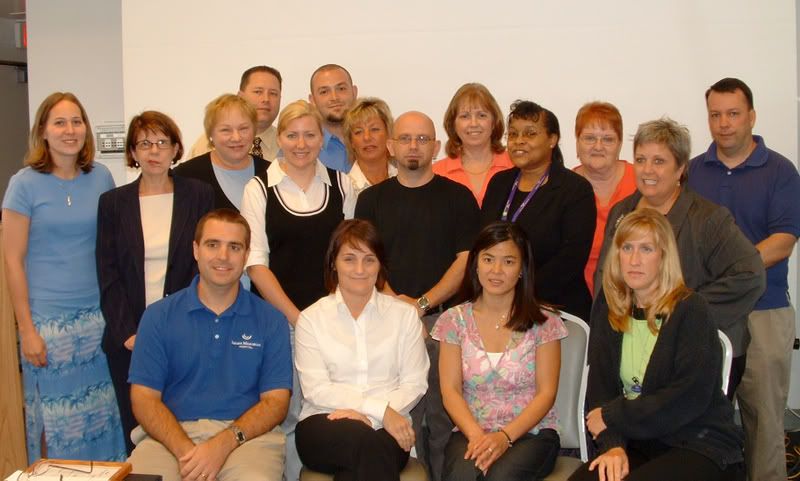
Congratulations to the Shore Memorial Graduates of our Making of an Effective Manager Course. In alphabetical order: Laurie Bartine, Jody Brady, Jon Cuviello, Sharon Dougherty, Michael Fox, Cheryl Franks, John Gosner, Anna Marie Guerrieri, Susan Krantz, Ken Michelette, Diane Miller, Denise Minus, Pam Mood, Sean Mulligan, and Karen Renzulli
The next Public Making of an Effective Manager Course starts September 17th at our Marmora Training Room. Managers will gain confidence to make the right decisions and will know how to motivate and retain employees. Don't forget this counts as continuing education credits!
More Information
We hope to see you and your managers there!
Monday, August 4, 2008
Adults Learn Differently
I have been training managers for over thirty years and I still find that most organizations have not realized that adults learn differently than children and for training programs to be successful, we must understand the methods needed to help managers realize their potential growth.
As Lisa Haneberg notes in her new book, “Developing Great Managers”, ASTD-2008, people who facilitate management and development programs must be well versed in management training theory (MTT): She lists the main tenants of MTT as follows:
· Managers are too busy therefore the training must improve their abilities to succeed or it won’t be worth the diversion. In addition, shorter training sessions are easier to fit into a manager’s busy day.
· Managers often suffer from fuzzy priorities, competing priorities, scope creep, and meeting overload. Management training should acknowledge and assist with these challenges
· Many managers feel overwhelmed and stressed. The best management training programs will reduce feelings of stress and being overwhelmed.
· Many managers work well below their capabilities. For managers to try new approaches, they need more training about how to conduct their days and why the techniques are recommended.
Most training programs do not address the basics of adult learning:
· Adult learners cannot be forced to learn
· Adult learners resist forced attendance at training sessions
· Adult learners are invested in their careers and achievements
· Adult learners take responsibility for their progress and appreciate clear, concise feedback on their development
· Adult learners responds well to real-world examples and applications
· Adult learners come to training with a years of developed behaviors, experiences, and knowledge
· Adult learners may be on the defensive when their supervisor recommends training
· Adult learners need to feel that the new information and skills directly relate to their job role and help them achieve their goals
In 1999, Innovative Leadership made a conscientious decision to make sure that all our programs and courses satisfy the basics of adult learning and MTT. We focus on an “application and action” methodology for learning. All of our training has a basic foundation that is research-based or validated by demonstrated results. We find that challenging the status quo is fun, but introducing something for fun is a waste of time and resources. We use a proven process for adult learning and facilitation.
We incorporate video and audio to reinforce the issues or key points of discussion. We find that people learn and retain more if they can “see it”, “feel it”, “taste it, and “smell it”. Many of our videos and audio are usually entertaining in nature but reinforce the research or content needed to be learned.
We also find that the facilitators of any adult training program must make the connection between the new material being introduced and the application of the learned material into the workplace. We tend to differ from the academic community in this regard since we use facilitators that have previous management experience so that this connection can be related to a real workplace environment and not a text book hypothetical.
Our public workshops bring management personnel together from all types of industries and we have found in our post – course evaluations that this small inter-disciplinary group found the open discussion on how the learned material was applied in their workplace environment was just as important as the learned material itself. Sharing the knowledge of how to apply the learned skill and seeing things from a different perspective are certainly two of the most beneficial components of our unique adult learning process.
We realized long ago that people development requires a learning environment where conversation is the key ingredient to adult learning. We focus on creating conversations whereby managers learn about techniques and then tell others how they have applied their learned materials in their work environment. We provide several tools that may help the mangers implement their newly learned information in the workplace and we evaluate and allow them to re-design the tools for a more effective outcome.
Speaking of outcomes; isn’t that what learning is all about? All of our programs are goal-oriented and give the participant the opportunity to set goals that will provide success for them as managers with a system to measure the results. Most workplace environments today are results-oriented so we need to focus our managers on improving their skills to produce a desired outcome, using the tools to implement the application for the learned materials, measuring the results in terms of performance and productivity and measuring the results for sustained growth.
You can choose any training company, program, or material. When you choose a vendor or program, please ask yourself the following questions prior to the selection:
- How does the management training program meet the standards established by MMT and satisfy the basics of Adult Learning?
- Is your management development program goal-oriented?
- What tools does your management training program provide to measure personal growth and development?
- Does your management training program provide a process for implementation or application?
- Is the ROI for your management training program available upfront and how is the success of your management training program measured?
Make sure your management training programs meet those requirements. If they do, you will see enhanced performance and improved productivity from your management team. It is the measured results that make the difference in achievement.
Tuesday, May 27, 2008
Training is a Waste of Time
This weekend, I opened the latest issues of Training and Development and my eyes were immediately draw to the title “Why most training is Useless”, written by David H. Maister. My initial “gut” reaction was to say, “Oh no, another article that I have to read and prepare a defense for.” As I continued to read, I started to become more in tune with the ideas presented and certainly started leaning toward the author’s point of view.
I have found that most companies expect training to provide a “quick fix” and they utilize the training as an event to “kick-off” a change initiative. This type of thinking will certainly lead to failure if the desired long term effect is a change in behavior or culture. It takes much more than training but when used properly, training can be the most positive factor in the achievement of the initiative.
I have found that most companies expect training to provide a “quick fix” and they utilize the training as an event to “kick-off” a change initiative. This type of thinking will certainly lead to failure if the desired long term effect is a change in behavior or culture. It takes much more than training but when used properly, training can be the most positive factor in the achievement of the initiative.
I have spent the last ten years in the business of training and I find that it is as difficult as ever to get anyone to view training as a process as opposed to an event. The reason we don’t usually see training as part of the process is that we have no strategy or plan to implement the change over time. We expect our trainers to sprinkle “fairy dust” over the participants and almost immediately, their company’s productivity and performance will elevate beyond possibilities.
I have only found a few companies where the leadership had a good understanding and visualization of the outcome resulting from the training. They know “what matters most!” but they aren’t willing to focus on a plan of action and implementation process to achieve the desired outcome. Most companies just ask, “What do you have for team building, conflict resolution, harassment, or what do you have to improve communication? We want to change behaviors and the culture but we don’t know what we want to look like.” We just want to get better and the prescription calls for training.
The right approach is to focus on the outcome and then determine the best format to present the knowledge, demonstrate how they can apply the knowledge, and monitor the results whether it is a behavioral or a culture change. Our unique adult learning process is much more effective than event training, yet we have never been asked what format we use to initiate change or focus on desired behaviors. Awareness is an event, planning is an event; implementation requires a process of application and understanding to provide a desired result. The process you choose is the most important ingredient, yet most don’t even care. The learning process you choose can make your training initiative not only immensely powerful, but effective as well. I really find it ironic that most executives are process and results-oriented except when it comes to training. Training is a process that needs to satisfy the needs and desired outcome for any organization or company.
Is your training initiative an event or a process? I bet I know the answer.
Subscribe to:
Posts (Atom)