Communication, forward thinking, prioritization, and other skills must
be learned and applied in the workplace by managers if we can expect to
improve employee engagement. Employees need a manager who is willing to
provide an “open” communication platform that includes feedback in a
timely fashion, candid discussion on performance and appropriate
behavior, a willingness to clarify expectations and use metrics to
measure results, and to include the employee in the awareness and
planning stages for the company’s vision.
Here are 5 Tips that we believe makes a difference in your business if put into practice:
Showing posts with label manager. Show all posts
Showing posts with label manager. Show all posts
Wednesday, August 14, 2013


Monday, June 3, 2013
10 Reasons Why Companies Should Invest More In Management Training
I’ll get straight to the point. Why should companies invest more in management training? Here are 10 simple reasons.
1) An employee’s relationship with his or her direct manager is the most important single factor in employee engagement.
2) Engaged employees are happier and more productive. Disengaged employees are frustrated and more disruptive.
3) Because there’s no widely agreed-on skillset for management (good managers come in all shapes and sizes), there’s an assumption everyone knows how to do it. This is akin to someone who’s never driven before being given keys to a car and told: “Drive.” (Many many years ago, this is how I first learned to manage. I blundered my way through it. Trial and error. It wasn’t pretty.)
Tuesday, June 19, 2012
6 Tips for Managers on Employee Relations
1. Establish a
Framework of Trust – it is imperative
that the leadership exhibit behaviors and actions in the workplace that are
consistent and fair. It is important
that you address their needs in a candid, reliable and consistent manner.
2. Clarify your
Expectations – Define your
expectations in a manner in which people can understand and be willing to
compromise if found to be overzealous with your projections. People know that they are being asked to do
more with less but be reasonable in your expectations of them and they will be
fair in their evaluation of you.
3. Focus on
your People’s Strengths – contrary to
popular belief, the most valuable asset of your organization is not your
people; it is the strengths of your people.
Making sure that the talents of your people are maximized to reach their
potential in an integral component of a high achieving organization.
4. Communication
Channels must be Open – focus on all
aspects of your communication including your non-verbal skills and make sure all
your vehicles for communicating with the workforce reflect a positive yet
realistic design for success.
5. Use
Delegation as a learning Experience – delegate
the workload to the people that want to learn and develop. Provide the instructions and demonstrate the
skill-sets that will make them successful with the assignment and monitor their
progress while being in a supportive role from start to finish.
6. Invest in
Development – People development
should be the primary responsibility of anyone in a leadership role. Managers must make sure that the work
environment is conducive for growth and development. An employee relation is helping people reach
their potential enabling them to be satisfied with their career pathway.
At Innovative Leadership, we believe that the growth
and development of people can make a difference with the success of your
organization. Click Here or Call 609.390.2830 for more
information on our Training and Development Courses
Sunday, February 19, 2012
How to Use Employee Engagement to Your Business' Advantage
Between the winter and the continued economic struggles, many employers are being lulled into thinking that all is well in the workplace. Turnover is down or non-existent, revenue generation is coming back ever so slowly, and costs have been brought in line. All of this can certainly give companies and organizations the impression that everything is on the upswing and “Life is Good”.
The problem is that when we come out of this economic recession, many people will start looking for other opportunities and in most cases; the good opportunities will be made available to your good people. People are not usually changing jobs for financial differences, but relationship differences. The relationship between the manager and employee is the key to retention of good/great employees.
The main reason for leaving a company is the fact that the manager is either doing something wrong or is just not providing the feedback needed for personal development and advancement. Managers must exhibit an interest in their people; learn to understand what motivates their staff, provide a realistic career path for advancement, and to maximize the talents of their key employees. Leadership and Management Development Programs are designed to teach people the skill sets and competencies that are needed to develop high performing employees in the workplace. Read about these programs here, but let’s get back to engagement….
High performing employees are not always the highly engaged employee. Managers must make sure that all employees are engaged and the key employees must be well aware of how their value contributes to the overall success of the Business Strategy of the company or organization.
Keep in mind, low turnover does not reflect high employee engagement. It doesn’t, but it can! You still need engagement driven by management.
How To Take Action
Wednesday, May 20, 2009
8 Ways to Keep Morale High
Adapted from "Pathways and pitfalls to giving Personal Recognition and Appreciation"
No matter how dazzling your recognition program, in the end employee morale depends largely on how skilled you are at making the staff feel appreciated. Keep in might these recognition rules:
- Be Democratic. Don't restrict praise to bona fide successes. You should also appreciate effort - innovative ideas that fall flat or good tries that fall short. People should know it's ok to fail as long as they give their best. And be democratic in choosing whom to praise as well as what to praise. The receptionist, cleanup crew, and other support staff may not be moneymakers but they're an essential part of a well-run operation.
- Be Nit picky. Dramatic success's are great but they're usually the result of the tiny, incremental things workers do each day. Don't wait for the obvious. Take note of the small victories that lead to the big wins.
- Be Quick. Don't delay in praising employees fir a job well done. You not only want to make workers feel good about themselves, but you also want to reinforce their positive behavior. That's easier to do when the incident is fresh in an employee's mind.
- Be Public. Praise done right doesn't only reinforce the behavior and boost morale of the employee involved, it also raises the performance bar and creates a positive environment for everyone else.
- Be Specific. Make sure workers understand exactly what they did right. Rather than saying "Good job!" say "You handled that irate customer beautifully." By being specific you prompt workers to make note of their brilliance for future reference.
- Be Brief. Although you want to highlight positive behaviors, it's not necessary to turn a pat on the back into a dissertation on, say, customer service. Let workers enjoy their victory and save the blow-by-blow for your next staff meeting.
- Be Solicitous. Go beyond providing moral support by asking if there's anything you can do to help workers continue to perform to their full potential. Offering assistance is especially important when praising strong effort that proved unsuccessful.
- Be Reflective. After offering your on-the-spot praise, review the episode and ask yourself whether you could have handled the moment even better. Appreciation isn't as effective when, for instance, a manager praises workers then takes credit for their accomplishments with senior managers. To be most effective, praise should reflect the culture of the department or organization.
Sunday, January 18, 2009
Key Areas of Focus for Managers
In these turbulent times, it is imperative that management create a plan of action that reflects the Strategic Business Objectives of the company and gets each and every staff member to be engaged in activities that will produce the desired outcomes. Here are my recommended resolutions for managers:
1. Focus on your key clients and make sure you understand the Pareto Principle…..the 80-20 rule that reflects the fact that 20% of your clients provide 80% if your revenue.
2. Improve communication with your staff and make sure that your platforms are effective. Make sure you spend the time for One-on-Ones with all team members.
3. Identify your key employees and make sure their development plan reflects a succession plan for your company.
4. Create Dashboards that reflect the financial implications including revenue generation, operating costs or expenses, and profitability by your area or department. Use Dashboards to make quicker decisions or take actions that are more effective.
5. Focus on your strengths and how you can elevate your performance without dwelling on your weaknesses.
6. Create specific metrics for your department and individual team members
7. Be open to create cultural change in your department and company.
8. Delegate and cross-train to the maximum.
9. Use technology to become more effective, not efficient.
10. Lead by example: exhibit a goal-oriented process at all times.
Tuesday, December 23, 2008
Ludgate Speaks on Roles and Responsibilities for EEO
Somers Point, NJ - January, 1 2009 - Equal Employment Opportunity (EEO) Compliance is a very important responsibility many companies do not take seriously enough. On January 21st, Rose Ludgate from Innovative Leadership will be speaking on the roles and responsibilities of management with EEO. The meeting will be held at Greate Bay Country Club beginning at 5:30pm hosted by SSHRMANJ. You can register at www.sshrmanj.org, prices vary for members and non-members.
You will learn the roles and responsibilities of managers with EEO Compliance. All managers must be familiar with the general requirements of Employment Laws in order to meet legal requirements and failure to do so can result in individual and company liability. Rose Ludgate is Innovative Leadership's Senior HR Consultant. She has 25 years of work experience in Human Resources including: Strategic Planning and Development, Employee Relations, Recruitment, Benefits, Administration and Training and Coaching. Rose holds Training Certifications and specializes in Affirmative Action, Equal Employment Opportunity, Diversity and Leadership Training. A graduate of Penn State University, she is a member of American Society of Training and Development and Society of Human Resources Management and The American Cancer Association.
Innovative Leadership is a performance improvement company that provides solutions for today's business challenges. They offer unique programs, products and processes that can be customized to fit the specific needs of your company. For more information, or if you would like Rose to speak at your next company engagement please call 609-309-2830 or visit www.ILDV.org
Tuesday, September 23, 2008
Manager vs. Man-Eater
I am starting to read articles in which many people have expressed an opinion that due to the tougher economic times, many managers and employees are starting to compete against each other in the work environment in unhealthy ways.
“Survival of the Fittest” has always been nature’s way of adjusting to the changes in the environment. Competition can be healthy or it can be destructive and it is important that the owner or senior management team, including the HR professional, focuses on the depth in which the competition presents itself. From past experience, we know that becoming “leaner and meaner” does mean that advancement opportunities are reduced and the workload per employee usually increases causing more stress in the work environment. Do we need to add a more competitive spirit to the equation or not?
Competition is one method many managers believe that can help individuals achieve their “real” or “true” potential. I am all for helping people reach their potential since most people believe that our capacity today is less than 10%, but competition is good as long as we can see the reason for our effort. Winning a race is a goal…..improving performance should be a goal. Competition may get us to the finish line in much less time than we ever imagined. This is good because we are getting closer to our potential.
What I see in many companies is this atmosphere of “competition” with no real goal defined. This lack of vision or visualization of the determined outcome must be classified as a communication disconnect. What happens too many times is that inappropriate behavior in the workplace becomes more evident as the competitive level rises. This “survival of the fittest” mentality takes hold and all the appropriate behaviors go out the window, like feedback in a timely fashion, recognition for something well done, and other basic collaboration practices.
When will we realize that when workers feel threatened, they usually don’t improve their performance but become disgruntled and belligerent? The worker becomes disengaged, discontented, and leaves the company.
Isn’t it time to focus on how we can better understand the employee by focusing on their behavioral style and communicate the organization’s objectives to them in a manner that is consistent and realistic? People need to hear the truth, understand the strategy of the leaders, and assume responsibility for their actions relative to the plan. They then need to set goals and set out to achieve them while monitoring their progress along the way.
Monday, September 8, 2008
Manager vs. Man-eater
I am starting to read articles in which many people have expressed an opinion that due to the tougher economic times, many managers and employees are starting to compete against each other in the work environment in unhealthy ways.
“Survival of the Fittest” has always been nature’s way of adjusting to the changes in the environment. Competition can be healthy or it can be destructive and it is important that the owner or senior management team, including the HR professional, focus on the depth in which the competition presents itself. From past experience, we know that becoming “leaner and meaner” does mean that advancement opportunities are reduced and the workload per employee usually increases causing more stress in the work environment. Do we need to add a more competitive spirit to the equation or not?
Competition is one method many managers believe that can help individuals achieve their “real” or “true” potential. I am all for helping people reach their potential since most people believe that our capacity today is less than 10%, but competition is good as long as we can see the reason for our effort. Winning a race is a goal…..improving performance should be a goal. Competition may get us to the finish line in much less time than we ever imagined. This is good because we are getting closer to our potential.
What I see in many companies is this atmosphere of “competition” with no real goal defined. This lack of vision or visualization of the determined outcome must be classified as a communication disconnect. What happens too many times is that inappropriate behavior in the workplace becomes more evident as the competitive level rises. This “survival of the fittest” mentality takes hold and all the appropriate behaviors go out the window, like feedback in a timely fashion, recognition for something well done, and other basic collaboration practices.
When will we realize that when workers feel threatened, they usually don’t improve their performance but become disgruntled and belligerent? The worker becomes disengaged, discontented, and leaves the company.
Isn’t it time to focus on how we can better understand the employee by focusing on their behavioral style and communicate the organization’s objectives to them in a manner that is consistent and realistic. People need to hear the truth, understand the strategy of the leaders, and assume responsibility for their actions relative to the plan. They then need to set goals and set out to achieve them while monitoring their progress along the way.
Wednesday, August 6, 2008
Shore Memorial Graduates
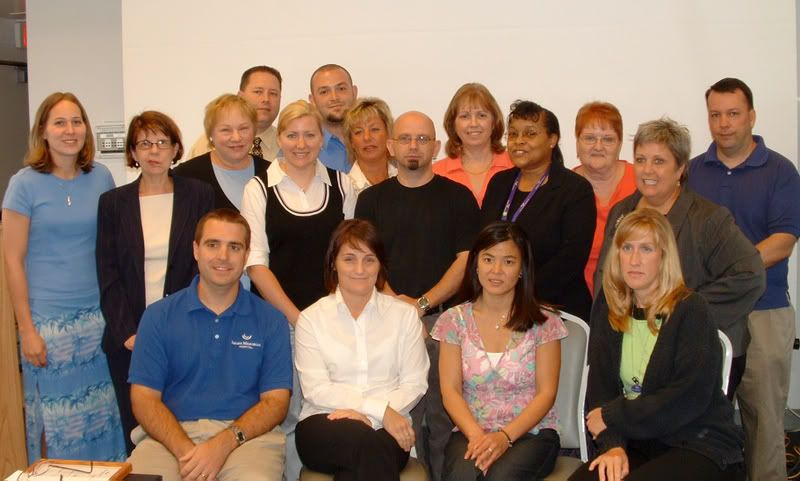
Congratulations to the Shore Memorial Graduates of our Making of an Effective Manager Course. In alphabetical order: Laurie Bartine, Jody Brady, Jon Cuviello, Sharon Dougherty, Michael Fox, Cheryl Franks, John Gosner, Anna Marie Guerrieri, Susan Krantz, Ken Michelette, Diane Miller, Denise Minus, Pam Mood, Sean Mulligan, and Karen Renzulli
The next Public Making of an Effective Manager Course starts September 17th at our Marmora Training Room. Managers will gain confidence to make the right decisions and will know how to motivate and retain employees. Don't forget this counts as continuing education credits!
More Information
We hope to see you and your managers there!
Monday, March 24, 2008
Gloom in the Workplace
Generational diversity is a not subject in the HR community and we all realize that in not the too distant future, we will have five generations in the workplace. Leadership IQ, a Washington DC based training company polled over 11,000 employees in the United States and found that all generations expressed some dissatisfaction. Furthermore, they note that the rate of disconnect was almost directly related to age. The older worker was the most satisfied and the younger generations expressed the lowest satisfaction rate.
The survey asked a variety of questions relative to the workplace and the management style being presented today. The title of the article was “Workplace Gloom is Universal” and appeared in the February issues of Training and Development by staff writer, Michael Laff.
We have focused our training and development course, programs, and processes on mid-level management and we also believe that many managers are not learning the intangible skills necessary to manage a staff. Most employees want feedback in a timely fashion and they want to know exactly where they stand if relation to their peers in terms of performance and productivity. Keeping the workforce content is not a priority in most organizations today. Competition, economic conditions, cost of materials and supplies, healthcare benefits and more are keeping us all very “short-sighted” with our employees. It appears that the younger generation craves praise and become frustrated easily. Don’t we all?
People skills have been lost in history. They obviously haven’t been passed down through the generations. It must be because the older generation has accommodated to the “lack of praise” in the workplace and is no longer offering that commodity. When will we realize that we must continue to motivate our employees and keep them engaged in the strategy and development of our company? If we don’t, they will continue to move on until another company does just that. How many jobs do we expect them to have by the time they are thirty five?
We need to start training our managers or that figure will be in double digits.
Wednesday, June 27, 2007
The Search For Talent - What Happens After the Boomers?
What are our real people challenges? Starting in three years, “Boomers” will be retiring at a 10 million clip per year for the next ten years. Many will continue to work but will work only where and when they want to work. This will leave us with a lot of part-time employees that require flex-time as a benefit. We will be at their scheduling mercy. The Department of Labor has been forecasting a major labor shortage of young people to fill the ranks. So, where are we going to search for talent?
In an interview The Conference Board of Canada conducted with leading management guru, Dave Ulrich, he emphasized that the 21st century will belong to human resources and to organizational capabilities. I agree with him as did the Conference Board of Canada. For the first time in the history of management, it is the human mind that is the primary creator of value. The quality of people and their engagement will be critical factors to both corporate and small business vitality and survival.
Companies must start building their leadership pipeline by formulating a developmental plan for its people. Leadership must be considered a role rather than a function, and individuals within a company must be called upon to exercise leadership within their spheres of influence internally. Succession planning by position and defining the importance of that position to the overall success of the company is a must. What is your succession plan for the future development of your company? What does it look like?
No market is more competitive than ours for employees. No market is more competitive than ours for management talent. In a tight labor market, like the one in which we are about to enter, a strong employment brand identity must be present. You will have to capture a larger portion of the employee mindshare by setting your company apart from the competition by branding your attractiveness to engagement. You will have to make sure that your employees are engaged and that they understand the real purpose of the organization. In our management development courses, we talk about “connecting the dots” for all employees within the company. Managers must exhibit the ways and means to motivate employees to become engaged and make sure at the same time they are connected to the mission and vision of the company. It is even more important that they understand the purpose. We need to provide an environment where the rate of learning exceeds the rate of change. Not an easy task even for the high achieving manager.
This culture of engagement and purpose can be achieved if we hire the “right person” for this culture. As business owners, we need to develop a Hiring and Selection Process that both demonstrates the flavor of our company in terms of a “brand” that attracts the candidate that is the “right person” for the position. What does your Hiring and Selection Process look like? Are you fitting the candidate to the job or the job to the candidate? You better get ready soon because us “Boomers” are coming and the fit needs to be right.
Author: Richard J. Hohmann Jr.
P:(609) 390-2830
Every Wednesday Join Us in a Complimentary Webinar
Subscribe to:
Posts (Atom)