Showing posts with label Innovative Leadership. Show all posts

Wednesday, July 31, 2013

Stress and Leadership

Stress is part of any job, and being in a position of leadership can add a certain level of constant pressure. Negative external stressors like the economy and even positive stressors like rapid growth can significantly add to the stress level in a leader’s life.  And while some level of stress is normal, too much stress can cause irritability, poor decision-making and even take a toll on your health.

During stressful times in an organization, a leader’s role becomes even more important.  Some leaders are naturally calm in the face of stress. Others may withdraw. Some exhibit extreme emotion.
Everyone has a different style of leadership, and each person reacts in a different way when faced with stress.  By examining our natural reaction to stress and how it manifests itself in our leadership style, we can equip ourselves with leadership qualities that are essential in stressful situations. This ability to adapt our leadership style to exemplify stability, control, and transparency will aid in successfully leading through stress.

Being able to manage through stress is so important in today’s workplace that leadership training organizations are beginning to build programs to help people learn to more effectively deal with stress in the work environment. Corporations are  developing employee wellness programs centered around both physical and emotional health.
Most experts agree that the best ways to deal with stress include:
  • First, identifying that you ARE under stress
  • Becoming better at planning and managing your time
  • Exercising, eating right, and getting enough sleep
  • Having a relaxation program that might include massage, meditation or reading
*What have you noticed about your own reaction to stress?
*How do others tend to react when you are dealing with a stressful situation?
*What tools or techniques have you found to be effective in managing stress?


Original post from http://blog.everythingdisc.com/380/stress-leadership/

Thursday, March 4, 2010

Mentoring Relationships - How to Foster Them

Assigning mentors is an important way to bring new hires up-to-speed or groom promising workers for better thing. But the strategy is only as good as the relationship between mentor and mentee.

Follow this advice:
- Choose Wisely - Of course, anyone would be thrille to work with a company or industry superstar. But you should select mentors based on what they can offer a particular worker rather than their glowing reputations. Talk to perspective mentors about their backgrounds and how they got from here to there, then pair them up with workers who have similar histories. Mentees should be able to look at their mentors and envision themselves having the same success.
- Offer Instruction - Ask mentors to make first contact to avoid putting the pressure on those in the subordinate role. Request mentors dedicate uninterrupted time to working with their mentees rather than allowing meetings to be disrupted by phone calls and other distractions. Mentees should be made to feel their advisors want to help them. And you may also suggest that inital meetings take place in neutral territory, such as a conference room, so worker won't be overwhelmed by ego walls and other trappings of success.
- Follow Up - Solicit regular updates from both parties - to ensure they are in fact meeting and to learn whether the relationship is having the desired effect. Street to mentees that they should be honest regarding how they feel about the process and not fear retaliation if they'd prefer to be assigned to another mentor. If they are not benefiting from the program, it's a waste of time for everyone involved.

Adapted from "Handle the Awe Factor" by Linda Phillips-Jones

Wednesday, December 30, 2009

10 Business reSolutions for 2010

  1. Conduct a SWOT Analysis for 2009 and analyze your sales, operations, people, and financial commitments.
  2. Conduct a Customer Satisfaction Survey to define benchmarks in your core competencies
  3. Develop a Strategic or Business Plan for 2010.
  4. Meet quarterly with your professional advisors (Accounting, Legal, Business Consultant, Financial Planner, etc.) to review progress and determine action plans.
  5. Focus your energies on your talented people
  6. Complete a course or take a workshop for self-improvement and/or business development
  7. Focus on your strengths, the strengths of your people, and your processes.
  8. Prioritize your tasks and make sure others do as well.
  9. Remember that time management is personal management.
  10. Celebrate success; offer praise and recognition to your top producers.
By Richard Hohmann, VP of Innovative Leadership
Business Consulting - Leadership/Management Development, Strategic Planning and more

10 Management reSOLUTIONS for 2010

  1. Make sure the business strategy is understood and clear to all employees
  2. Make sure the employees understand how their value and job roles contribute to the overall success of the business
  3. Improve your communication with employees
  4. Help people reach their potential through coaching and/or mentoring
  5. Make sure you are consistent in your message and actions
  6. Focus yourself and all the employees on the “High Payoff Activities”
  7. Become more goal and results-oriented
  8. Understand that you are responsible for employee engagement.
  9. Focus your energies on people development and career enhancement
  10. Understand that the tools of accountability (data, metrics, analysis, assessments, and performance evaluations) are neutral and need to become the tools that high achievers use to understand and improve performance.
By Richard Hohmann, VP of Innovative Leadership
Making of an Effective Manager Course 2010

Wednesday, December 9, 2009

Critical Business Success Factor

Many experts feel that even though every company is different, it is important for each to develop a succession plan that includes hiring from within, conducting a developmental opportunity or audition, providing a defined plan with time lines for anyone to assume a leadership responsibility, and disclosing the process or succession plan to the shareholders.

Most succession plans do not take into consideration that different environments require different leadership competencies or skills. So, if we narrow our development process than we may never have the right person ready to assume the leadership role in any company. Companies need to consider what most professional sports teams do as a major component for success and that is a strong bench. Most championship teams, whether it be in basketball, baseball, or even football have a great bench or understudy for their key positions. Companies, like professional sports teams, must have a strong bench of candidates who can lead or “step up to the plate” under a variety of scenarios.

Many companies use different forms of people development processes. Some companies call them Leadership Academies or Institutes, and/or High Potential Candidate Schools. Despite the different names, the end result is the same: development of people toward a higher level. As a business owner, you need to provide a constant flow of internal talent but you also must be aware that when people don’t get the higher position, they do have a tendency to leave the organization so the funnel better continue to be adequately filled at all times.

It is also important for companies to deliver some kind of transparency to their shareholders, customers, and internal personnel. The ideal succession plan should minimize uncertainty, which is not a bad thing in this economic climate, and continue to promote the “real” culture of the company. The depth of the company’s disclosure should be predicated by the need at the time and situational circumstances.

Also, many experts believe that the succession plan must take into consideration the corporate culture to the extent that every company should have a corporate culture that transcends the exit of any leader or person. Most companies do not really know what they smell, taste, and feel like to their internal and external customers. The best way to determine the current culture and the culture employees want is to conduct an Organizational Needs Inventory (ONI) assessment but most companies don’t do them.

So, succession planning is just a more formalized name that can be defined as a process to help companies develop their people to meet their future needs.It certainly sounds like it is time for a Leadership Program! Let's get started!

Thursday, December 3, 2009

Avoid Being the Black Cloud of the Office

AND Show Your Positive Side
If your boss had to characterize your attitude, would you be described as a ray of sunshine or a black cloud? Some employees don't realize that they unintentionally project negativity. To become the employee that the boss can't wait to see in the morning, take these steps:

  1. Suggest Don't Complain - If you disagree with a new procedure or rule, offer alternatives and solutions not recrimination and a bad attitude
  2. Air Problems in Private - Don't challenge your boss in front of co-workers or other managers.
  3. Learn To Pick Your Battles - There are times when it's best to keep quiet and do what you are told. Not every battle is worth fighting. Winning can cost you more in the end than the battle was worth.
  4. Take Responsibility for Your Mistakes - Show your maturity by admitting when you are wrong.
  5. Be a Team Player - Give your boss positive information about co-workers or jobs well done.

- Adapted from "Tips for Communicating Effectively with Your Boss"

Tuesday, November 24, 2009

Let It Be...Let It Be

Let it Be was in fact the last Beatles album released in 1970 and the song was written by Paul McCartney which was inspired by his mother. I read a recent article that authored by Michael O’Brien titled, “Tardiness is on the Rise” and was published online by LRP Publications.

That exact song title came to me immediately upon starting to read the article, but as I continued to read on, the content contained in the article got my juices flowing.

It was noted in an earlier survey that more than 1 in 5 workers say they arrive late to work at least once a week and another 10% say they are late at least twice a week.

Some people believe that the rise in tardiness is directly related to the economic times and is more of an employee defense mechanism. People are now relating tardiness to specific behavioral patterns normally associated with procrastination. Behavioral change is possible and can be accomplished in good or bad economic times.

Other experts think the reason for tardiness has more to do with demographics as opposed to individual behavioral styles and the climate of the economy. Billy G. Blair, President and CEO of Change Strategists, Inc., a Los Angeles-based consultancy, and author of All the Moving Parts: Organizational Change Management says that the increase in lateness may correspond to an increase in the number of “millennials” in the workplace. She also says the “factory model” of being in a certain place at a certain time and predetermined duration is outdated. The “factory model” may be outdated but in many businesses today, coverage remains an important responsibility for the worker. Flex-time may help support the needs of the employer and the worker but random flex-time rarely provides a viable resolution for both.

Wake up! Work does not necessarily begin wherever you are, and the customer is not always available at the times you would like them to be. It just might be that in some workplaces today, consistency is more important than flexibility. Focus your culture on the customer, not the millennial. Oh, well, I guess I should Let it Be!

Article written by Richard J. Hohmann Jr., SeniorInnovative Leadership, a performance improvement company that integrates business consultation, training and development, and coaching with Leadership and Strategic/Forward Thinking to enhance organizational effectiveness and people development. Richard is a member of the Collaboration Team for Leadership Management International and a strategic partner with the accounting firm of Fitzpatrick, Bongiovanni, & Kelly, PC. For more information visit www.ILDV.org. Business and Management Consultant for

Friday, October 23, 2009

Do you have the right focus?

It seems like the HR professional must continue the fight for training and development since it does not appear that the CEO has realized the value of training to the company or organization.

Companies focus on profits, stock prices, and performance, but not on employees. How do we forget to see the value in our people, particularly our key employees, when it comes to celebrating our business outcomes? Studies have shown that companies that invest more heavily in training and development have been more successful in achieving their defined outcomes.

Many of the recent studies have concluded that a more engaged workforce provides enhanced performance and improved productivity. Companies with a more engaged workforce seldom have morale issues. “In the 21st century, our natural resource is our people – and their potential is untapped and vast. Skills will unlock that potential.” (Leitch Review, December 2006) Even with the economic climate of the past year or two, it has been demonstrated that training expenditures were a strong predictor of stock prices.

So where is the hidden agenda? Is any CEO really interested in the productivity and developing the potential of their people or is the real objective of only reducing cost associated with people including the people themselves. I have seen a decrease in revenue of less than 10%, yet the company has reduced its labor forces by almost 30%.

Training the management of any organization will certainly prove to make the organization more effective. People are looking for advancement and an opportunity to develop skills to assist with their upward mobility. They want feedback immediately from their supervisor and they want to work in an environment that supports their development. The social culture that is presented today by companies is very important to the millennial generation. Many believe that a budget for employee development indicates whether a company is in it for the long haul or not.

If we expect to retain our top producers in the management positions, we better make sure that they have the skills and competencies to work with four generations of workers. This ensures that knowledge is shared, cross-training is completed and the work is getting done in a timely fashion. We need to teach our management team that communication is the key to people success and that success can only be achieved if we develop people’s potential and focus on productivity and performance, and not just trying to reduce costs. Reducing training budgets can be detrimental.

We are fortunate that the economy has kept the Baby Boomers in the workforce but how long will that last? It looks like we will be left with an untrained workforce that doesn’t like to communicate with others. It sure sounds like it might not be the best time to be in a management position.

Come on Mr. CEO; listen to your People Developer. Investing in your management team will produce an improved bottom line. If you don’t believe that training and development can affect the bottom line, just look at how the reduction in their training budget prepared Wachovia for the merger with Wells Fargo. Their training budget was reduced by over 50% and their stock fell as much as 95% before the bank finally agreed to the merge. Helping people reach their potential, coupled with effective processes and procedures can certainly affect the effectiveness of the organization.

The time to train is now and please pass this on to the decision makers in your company!

Thursday, July 23, 2009

Is anyone still listening?

The confidence from the C-suite to the employee is down in most companies. The conversation is focused on cost containment and expense reductions. Budgets again are being slashed and people are being asked to “do more with less”.

Many companies are discarding the talent that took them to the top. Experts today note that Talent Management is more important than ever but it appears to be falling on deaf ears.

Are you listening?

Changes in the economy are often precursors to changes in the ways we do business. Why are we still focused on everything except what we need to do? We need to retain top talent and develop the future talent for our company needs. The ASTD just published a major report titled, Mission Critical – Keep Learning. This publication demonstrates “How to Communicate the Value of Learning in Difficult Economic Times”. Their publication is calling for all learning professionals to get in involved and make sure they contribute to a successful talent management strategy. The author feels that the ability to get the right people with the right skills into the right jobs in a cost-effective way makes it possible for a company to respond strategically. The publication also goes on to say that the entire organization must make the learning function support the organizations goals. The key decision makers in the organization must see a meaningful relationship between learning initiatives and results. Now there is a thought! Be more effective than just focusing of efficiencies. Isn’t it time to make sure that all programs focused on people development are directly linked to business goals?

Are you still listening?

The next thing is for everyone to realize that our middle management is the “glue that holds the company together”. I just recently read an article in HR Daily Advisor titled, “Top Five Mistakes Leaders Make in Tough Times”. In her opinion, Ellen McDargh,CSP, CPAE, felt that in tough times, leaders become reactive and reactionary, huddle with only the corporate folks, subscribe to the “cut…cut…cut” philosophy, target new clients and customers, and subscribe to the “do more with less”. Middle management is the leader of the majority of the staff. They must focus on being effective and producing the desired results in areas that have been bludgeoned to death by cost containment measures and layoffs.

A recent survey of the American workers demonstrated that “Good Management” is the most important thing that employees want in the workplace. Things that finished far behind “Good Management” included respect of colleagues, money and benefits, learning new skills, and having a fun environment.

Is anyone listening?

We need to make leaders out of every employee but the most important ingredient for business success is the development of the middle manager. Middle management must elevate morale in poor economic times, retain and motivate the high achieving employee, their team is expected to comprehend the “bigger picture” in terms of strategy and recommended plans of action. It is more important for the middle manager to break down the strategy into goals that can be comprehended and implemented by the action of the staff. They need to give direction, monitor performance, discipline the staff, and demonstrate organizational effectiveness by getting results. In addition to all of this, they have to understand that their actions may put them in the same legal liability position as that of their company. That’s quite the responsibility! Shouldn’t they continue to learn how to manage their employees as well as themselves?

I have read article after article on the Benchmarks involved with Human Resources Departments and have not found Mid-level management development as one of the major benchmarks for success. I have heard about the metrics associated with organizational performance, HR service and delivery, employee engagement, voluntary turnover, HR practices, budget management, technology assessment, and more. What is HR and the C-Level doing to continue their company’s success??

Here at Innovative Leadership, we have focused our company on the development of middle level managers and our programs compliment all of the metrics ever associated with a strategically oriented HR Department:

  1. Tools that qualify potential management candidates from the date of hire.
  2. Training and Development Courses that highlight goal-orientation and business results
  3. Provides an organization with the ROI prior to the start of the program
  4. Offers a variety of cost effective platforms including online application.
  5. Course evaluation processes measure the changes in the behaviors and skill-sets associated with high achieving mid-level managers

We do things differently and our results demonstrate just that. Please tell me just one thing . . . Is anybody still listening?

Wednesday, May 20, 2009

8 Ways to Keep Morale High

Adapted from "Pathways and pitfalls to giving Personal Recognition and Appreciation"

No matter how dazzling your recognition program, in the end employee morale depends largely on how skilled you are at making the staff feel appreciated. Keep in might these recognition rules:
  1. Be Democratic. Don't restrict praise to bona fide successes. You should also appreciate effort - innovative ideas that fall flat or good tries that fall short. People should know it's ok to fail as long as they give their best. And be democratic in choosing whom to praise as well as what to praise. The receptionist, cleanup crew, and other support staff may not be moneymakers but they're an essential part of a well-run operation.
  2. Be Nit picky. Dramatic success's are great but they're usually the result of the tiny, incremental things workers do each day. Don't wait for the obvious. Take note of the small victories that lead to the big wins.
  3. Be Quick. Don't delay in praising employees fir a job well done. You not only want to make workers feel good about themselves, but you also want to reinforce their positive behavior. That's easier to do when the incident is fresh in an employee's mind.
  4. Be Public. Praise done right doesn't only reinforce the behavior and boost morale of the employee involved, it also raises the performance bar and creates a positive environment for everyone else.
  5. Be Specific. Make sure workers understand exactly what they did right. Rather than saying "Good job!" say "You handled that irate customer beautifully." By being specific you prompt workers to make note of their brilliance for future reference.
  6. Be Brief. Although you want to highlight positive behaviors, it's not necessary to turn a pat on the back into a dissertation on, say, customer service. Let workers enjoy their victory and save the blow-by-blow for your next staff meeting.
  7. Be Solicitous. Go beyond providing moral support by asking if there's anything you can do to help workers continue to perform to their full potential. Offering assistance is especially important when praising strong effort that proved unsuccessful.
  8. Be Reflective. After offering your on-the-spot praise, review the episode and ask yourself whether you could have handled the moment even better. Appreciation isn't as effective when, for instance, a manager praises workers then takes credit for their accomplishments with senior managers. To be most effective, praise should reflect the culture of the department or organization.

Wednesday, April 8, 2009

Evaluate Talent from Day One

Where is Your Focus? on Your People or on Your Process?

In a recent article in the Investor’s Business Daily, Kevin Harlin points out that Employment consulting firms say it is vital to track and nurture promising leadership candidates even though the economy is sluggish. Steve Krupp, partner and leader of the executive talent management practice at Delta Organization & Leadership, asserts that if a company fails to engage and communicate its top performers, they might be inclined to depart.

Rather than focusing on your processes, focus on your people. They are your biggest asset. Remember that turnover can cost you double of just one employee’s salary. A survey from Delta found that most U.S. companies fail to monitor their best performers, even fewer communicate with these employees, and few top executives support such initiatives.

PPG Industries, a global glass, paint, and chemical firm, has been tracking its best employees for about a decade. Roughly 30 percent of workers are regarded as top talent, and just 1 percent is deemed suitable for the CEO position. Identified employees get first priority for training, special projects, and responsibilities. Executives also meet with these employees from time to time at informal settings like breakfast or lunch. Global business software firm SAP provides potential leaders with six-month fellowships in another division, typically in a different location, to ensure that these employees have adequate insight into the company.

The above synopsis of the article that appeared in Investor’s Business Daily demonstrates the need to evaluate talent from the first day of hire in terms of recognizing potential and people development as the priority for any organization. I really question whether companies today are focused on their future leadership and understand the need to develop people’s potential.
Innovative Leadership offers an Assessment Process called the Achiever Series that can assist you with people development and also compliment certain aspects of succession planning, downsizing or transformation.

We are a company that is focused on helping companies develop their potential of their people that will result in organizational effectiveness. Please call us at your convenience to discuss our Assessment Processes that can make the difference in the future of your company at 609.390.2830.

Saturday, January 3, 2009

It's Time to Pay Attention to Personnel

We should never lose sight of the fact that people make a company what it is today and what it will be tomorrow. Also, we should not forget our people in the development and organizational sense as well as the retention situation. Have we taken our people for granted? Like other industries, the employee in the Home Healthcare market does not always feel as passionate as the owner about the mission of the organization, and they may be confused about how they fit in to the organization’s changing future. Many employees are becoming discouraged when they hear or read about the industry’s problems.

In all types of industries, the training and development of the employee is usually ranked first or second by most surveys listing the Top Five Methods to increase employee retention. 73% of all companies provide Leadership Development Programs, with Team Building, and Empowerment Programs. However, in the Home Healthcare Industry, many of the key executives, managers, and supervisors in a Home Health Care company are licensed professionals with extensive clinical backgrounds, but they possess very little in the way of formal management training. Is it like this for your company?

Home Heathlcare example of business: Take orders for products. Process the order after it has met all the qualifications. Deliver product in a timely manner with minimal expense and upon receipt of acknowledgment of delivery, bill the appropriate payer and await the payment that normally takes approximately 85 days or more. Phew!

How many people in your company get involved in any of those above processes? Now is the time to develop both your people and organization simultaneously to improve productivity and profitability through training and education. Leadership starts at the top. The application of this type of training, both philosophical and practical, must be instilled in all managers and supervisors by the executive team. Many companies suffering from the normal industry problems can provide resolutions to such by looking at organizational and personnel development that can lead to enhanced performance with improved productivity. There is no better time than now for the small to medium sized business owner is to start acting like a real leader and develop your people to make your company stronger to handle this highly competitive environment.

Leadership Management Programs are available in presentation, seminar, or spaced- repetition formats. A spaced - repetition program is convenient for most management in the fact that the time required for presentation will allow the manager to miss the least amount of time from the office. It also will provide multi-sensory impact, compliment the classroom activities with audio reinforcement, and allow the participant to complete assignments at home or at work. More importantly, it has been demonstrated that participants completing such programs implement more course techniques into their daily work activities and change many of their current behavioral processes. Almost any program, product, or process can be customized to meet the needs of your company. Every member on your management team should participate in a Leadership Management Program custom designed to compliment your mission, vision, and values. Quality management starts at the top and the best way to demonstrate such is to “lead by example”.

For more information on our management training visit www.ILDV.org or call 609-390-2830.

Sunday, December 28, 2008

Where is your Focus? People or Process

In a recent article in the December 22nd issue of Investor’s Business Daily, Kevin Harlin points out that Employment consulting firms say it is vital to track and nurture promising leadership candidates even though the economy is sluggish. Steve Krupp, partner and leader of the executive talent management practice at Delta Organization & Leadership, asserts that if a company fails to engage and communicate its top performers, they might be inclined to depart.

Rather than focusing on your processes, focus on your people. They are your biggest asset. Remember that turnover can cost you double of just one employee’s salary. A survey from Delta found that most U.S. companies fail to monitor their best performers, even fewer communicate with these employees, and few top executives support such initiatives.

PPG Industries, a global glass, paint, and chemical firm, has been tracking its best employees for about a decade. Roughly 30 percent of workers are regarded as top talent, and just 1 percent is deemed suitable for the CEO position. Identified employees get first priority for training, special projects, and responsibilities. Executives also meet with these employees from time to time at informal settings like breakfast or lunch. Global business software firm SAP provides potential leaders with six-month fellowships in another division, typically in a different location, to ensure that these employees have adequate insight into the company.
The above synopsis of the article that appeared in Investor’s Business Daily demonstrates the need to evaluate talent from the first day of hire in terms of recognizing potential and people development as the priority for any organization. I really question whether companies today are focused on their future leadership and understand the need to develop people’s potential.

Innovative Leadership offers an Assessment Process called the Achiever Series that can not only assist not only with people development but also compliment certain aspects of succession planning, downsizing or transformation.

We are a company that is focused on helping companies develop their potential of their people that will result in organizational effectiveness. Please call us at your convenience to discuss our Assessment Processes that can make the difference in the future of your company at 609.390.2830.

Saturday, November 29, 2008

Why. . .Why. . .Why? The Need to Understand.

By Richard Hohmann

At the most basic level of alignment, companies must make sure that employees understand how the company makes money. Employees need to understand the basic financial facts about not only how the company makes money but how revenue drives profitability, and how cash flow can inhibit growth or how cost reduction can impact success.


Since mid-level managers are the ones left holding the bag in terms of communicating with the workforce and we better make sure that our managers have a high level of business acumen so that the employees can have confidence that the decision making process is based on something more than a gut feeling. Understanding the financial thread that ties everything together in the company better not only be understood but communicated to the employee. The engaged employee wants to know why. Why did we decide to do that, why did we layoff people in our most productive department, why aren’t we advertising in the Wall Street Journal? People want to understand and the best way to get them to understand is to talk the talk – business acumen.


Workers just might start to understand how difficult it is to be successful in reducing costs when healthcare costs have risen in double digits for the past five years, fuel costs have doubled, and fortunately have come back down to a reasonable rate. People need to understand that their performance in their role directly affects the success of the company.


Let’s start talking to and training our Middle Management and employees about Business Acumen, Decision Making, Problem Solving, and basic finances. Provide a real foundation for not only communication, but for action plans and for people development that leads to organizational effectiveness.


It is really getting rough out there and you need to keep your key employees informed. Your employees count on leadership to be the visionary and they want to know what you see as well as what they are reading in the newspaper or hearing on the TV. Now is the time to communicate that the strengths of your people make the difference in organizational effectiveness. We all need to improve our skill-sets and competencies when times get rough but we must understand why we need to do that.

Tuesday, November 18, 2008

Where have All the Leaders Gone?

One financial advisor stated that we are in the middle of a very dark tunnel. If that be the case, I guess I can say that I don’t see light in either direction. The economy has offered some hiccups but no demonstrable change and it does not appear to look like there will be any major change in the very near future. We are in a bail-out mind-set and it is kind of frustrating when most small or even mid-size companies have no real safety net to protect them from making bad decisions. The job market is much worse today than it was even two months ago. So where is the light going to come from?


Possibly the most frustrating thing for leaders and managers is that they have to personally manage the employees so that they stay engaged in their jobs and don’t get distracted by the lack of sunlight. I would go even further to state that much of the leadership prefers to stay in the dark and not come out into the light, if there is any, and address the issues straight forward with their employees.


A recent survey from the public relations firm of Webber Shandwick noted that 71% of workers felt leadership should be communicating more about the current economic conditions and 54% of the workers have not heard anything from their leadership on how these conditions might affect their company and positions. On top of that, it was interesting that almost 75% of the workers said they had heard their colleagues and co-workers talking about the subject, but not the leadership of the company.


Where have all the leaders gone? Maybe they don’t realize that it is a tunnel and mistook the current environment for a cave. I really believe that leadership today is scarce and middle management is being forced again demonstrate that they are the glue holding the worker to the strategy of the company. Engagement is more than having fun in your job. It is an understanding that your contribution is significant in regard to the overall effectiveness of the organization. This engagement process must incorporate the alignment of individual goals with those of the company, demonstrate why performance management can make a difference, and the really great companies focus on their strengths to get them through the rough times and they do this by planning.

Wednesday, November 5, 2008

Equal Employment Opportunity and Affirmative Action

Do you know what EEO and AA laws really are and how much they can both affect your company? Equal Employment discrimination charges and alleged wrong doing is a reality. Our workshop, on November 13th will teach you have to run a compliant EEO and AA company. Hiring, Promoting, and even project delegation can be a potential litigation. Attend this workshop and stop guessing if you're compliant with these laws, know it.

As mentioned in prior posts, we have a new Senior HR Consultant,
Rose Ludgate. In this 1/2 day workshop she will be teaching you how to attract, develop, and retain people with a mix of talents, experiences, and perspectives.

11/13/08 8:30am-12pm
Location: Marmora, NJ
Registration Fee: $79, includes EEO and AA samples to take to your company.
This 1/2 day workshop is for the business owner, manager, or anyone in a leadership position. Attract, Develop, and Retain people with a mix of talents, experiences, and perspectives.

You will also learn and understand the Title VII of the Civil Rights Act of 1964, which prohibits employment discrimination based on race, color, religion, sex, or national origin. More Info

Register Now

Tuesday, October 7, 2008

Monday, August 11, 2008

Congrats, MORE GRADS!

Congratulations to the newest "Making of an Effective Manager" graduates. Each grad earned 6.6 continuing educational credits.
Also, available
as New Jersey State Nurses Association: 67.1 contact hours,and State of New Jersey Board of Accountancy: 28 CPE. Read more about this course here

Wednesday, August 6, 2008

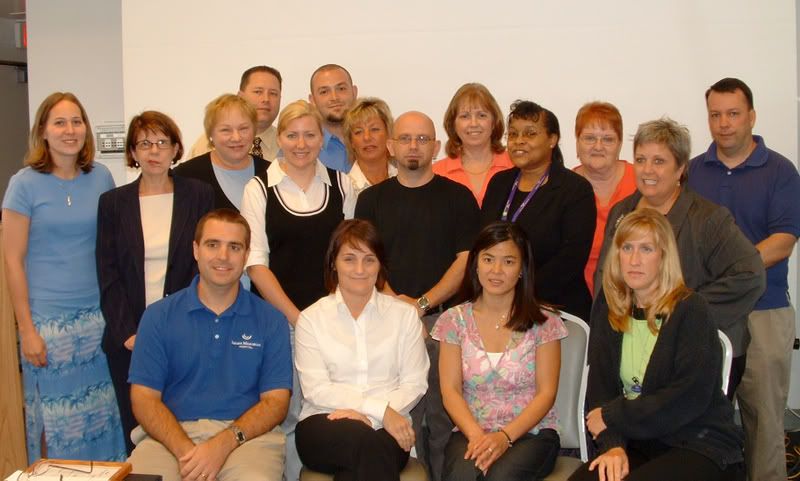
Shore Memorial Graduates


Congratulations to the Shore Memorial Graduates of our Making of an Effective Manager Course. In alphabetical order: Laurie Bartine, Jody Brady, Jon Cuviello, Sharon Dougherty, Michael Fox, Cheryl Franks, John Gosner, Anna Marie Guerrieri, Susan Krantz, Ken Michelette, Diane Miller, Denise Minus, Pam Mood, Sean Mulligan, and Karen Renzulli

The next Public Making of an Effective Manager Course starts September 17th at our Marmora Training Room. Managers will gain confidence to make the right decisions and will know how to motivate and retain employees. Don't forget this counts as continuing education credits!
More Information

We hope to see you and your managers there!