Tuesday, January 29, 2008

Congrats to New "Making of an Effective Manager" Graduates!

"The Making of an Effective Manager" focuses on giving your managers skills necessary to become 'high achieving' managers. Course Curriculum, View Available Classes
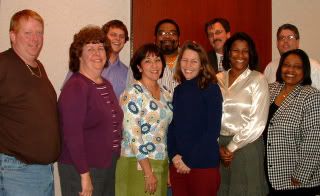
Photobucket - Video and Image Hosting


1st Row:
Mark Corey, Atlantic County Utilities Authority
Carolyn Conover, Atlantic County Dept of Intergenerational Service
Cindy Smith, Atlantic County Dept of Family Community Development
Terry Petruzzi, Atlantic County Animal Shelter
Karla Guy, Atlantic County Dept of Family Community Development
Audrey Alpheaus, Atlantic County Dept of Family Community Development

2nd Row:
Ryan Broadley Driscoll, Broadley Mechanical Contractors
Clarence Davenport, Atlantic County Dept of Family Community Development
Jeff Monroe, Atlantic County Dept of Human Services
Bob Ellis, Fitzpatrick, Bongiovanni, and Kelly CPAs

Not Pictured: John Hurff, Gleeson's Audio Video

"I just completed my last class tonight and I want to thank the ACUA for allowing me to attend this class. This class was spread out over sometime and I feel that this made it more of a learning experience over the time and I highly recommend this class for all the group leaders." - Mark Corey, Group Leader, ACUA

Monday, January 28, 2008

Why Hire a Coach? By Richard Hohmann

Work–Life Balance still a Key Issue for Men

A new Workplace Insights survey found out that half the moms say they split their time equally between work and home while just thirty – two percent of the men said they balance their work-life equally.

Men have a more difficult time of balancing their work-life and really would prefer more flexibility that would enhance their work-life balance. Flexibility doesn’t replace good time-management skills and most male managers need to improve their time management skills. They attempt to use the latest electronic devices to compliment their lifestyle but end up spending thirty percent more time working with the device as opposed to just writing it down, on a legal pad or whatever is available.

The use of a paper planning and administration system may save you up to thirty minutes a day, but who’s counting? Make sure you use the tools that compliment your work-life goals. A Business Coach who is well versed in Time Management techniques can offer you options that may help satisfy that work-life dilemma. Remember, just because you think it should work better, doesn’t always mean it does.

Richard Hohmann is the leading Coach of Innovative Leadership. Call to test drive coaching for 30 min, no obligation. 609.390.2830.

Wednesday, January 23, 2008

The Weather Outside is Frightful!

Don’t let this holiday song provide a foundation theme for 2008! You certainly can tell it is winter by the methodology being used by the weather forecasters to panic the local residents into spending hours at the grocery store buying all the necessities for a mid 1950’s blizzard. I sit there listening to them tell me that the potential for the front moving rapidly from the South up the coast colliding with the Arctic air being driven down by a Canadian high located over some Lake near Michigan should produce a tremendous snowstorm that supposedly we have all been waiting for. I wake up the next morning and I find a “dusting” if anything but the result of the forecast is that WAWA has sold more milk and bread compared to previous snow storm announcements (for those not in the Philadelphia market, WAWA is the leading convenience store where you buy milk and bread) We are starting to hear the same thing about a global recession. After conducting their annual S.W.O.T., it has now become part of everyone’s strategic plan to list an economic recession as the major external threat that may affect their business success for the upcoming year. I guess we better get in line at your local WAWA to buy cost reduction measures, recession-proof armor, revenue producing fairy dust, and more. Unfortunately, I can feel the cost-cutting measures starting to unfold as I am writing this article.

There is no question that the economy may more than likely turn “chilly” in the upcoming year and the predictions for the real estate market continue to appear “frigid”. Forecasters are predicting that there is a heightened interest in career development and paying down personal debt. Business leaders have learned in 2007 that employee loyalty is waning as employer commitment begins to weaken. The generational shift in ownership in small businesses and the retirement rush is the corporate environment has begun and will accelerate in 2008. Economic trends are being characterized by shorter job tenures, changing generational values, scarce talent, and a surplus of vacant positions.
Statistically it is well documented that these trends are real. These trends are affecting all levels within an organization and we need to focus on the acquisition of talent, identification and development of leaders within an organization, and the retention of good employees. Survey after survey demonstrates that most businesses believe there is a current shortage of quality leadership talent in the workforce and they measure personality or behavioral styles when identifying future leaders. It is also well documented that most companies have not implemented an adequate leadership development plan and not focused on the emotional intelligence of the future leader.
The real concern for me is that most companies still do not realize that their people offer them the most competitive advantage in any economic climate.
First, it is important that you do not let the business weatherpersons scare you into a cost-cutting frenzy in that areas of business that means the most to your employees. Second, leadership and career development cannot be achieved without an effective training and development process. Not a program, but a process! I ask you to be innovative in the selection of your tools and products for this process and of course, make sure they are cost – effective but most importantly, produce the desired results or behavioral change that your company needs to be more competitive in 2008. Don’t let the forecasters scare you into cutting the processes that will mean the difference for your future.


Innovative Leadership offers training and development for all levels of your employees. Executive Coaching, Manager Training, and even Customer Service. Get more competitive and make a difference with these programs and processes. Contact us to get started today!

Monday, January 14, 2008

HR Needs to Step Up to the Plate!

It is well documented that most companies have a formal strategic-planning process but don’t use it to make many of their most important decisions. Less than half of the respondents of a recent survey demonstrated that they are satisfied with their company’s approach to making strategic decisions. It has also been demonstrated that greater satisfaction could come from improving the company’s ability to align their people with their strategic plan and from monitoring progress against the plan.

So what are we doing wrong? Are we not looking at our current methodology for both the creation of the plan and the implementation of the needed actions? The missing link is usually found within the implementation or monitoring component. It is projected that 65% of the components of most plans never even get implemented. Is it because we aren’t willing to put the time and energy into the implementation process or we don’t consider it a high priority?

Strategic Planning is critical to the continued success of any organization yet most employees feel that critical decision-making is left to a select few. The two top suggestions for improving the company’s approach to strategic development are: improve the alignment with the strategic plan and develop better methods to monitor progress against the plan.

Surveys have also demonstrated that executive concerns about executing and aligning strategy are likely exacerbated by a perceived lack of integration between the company’s strategic-planning group and its human resource group. When asked to consider strategic planning’s integration with several corporate functions, respondents in a nationwide survey ranked HR as second-to-last in terms of degree of integration. Respondents who were dissatisfied with their company’s strategic planning see the least integration.

Isn’t it time that HR steps up to the plate and take the integration of strategy and people seriously? What does your Strategic Development Process look like? Who is willing to hold people accountable for the success of the plan? It sure sounds like HR or anyone else for that matter is not willing to focus on the outcome. It seems to me that we should all take time off and read the “Five Dysfunctions of a Team” by Patrick Lencioni. It talks about trust, conflict, commitment, accountability, and results……five things that we just seem like we don’t want to address. It sounds like no one is willing to stick around to see the outcome.

Wednesday, December 19, 2007

Bah Humbug - Talent Management

It has been over ten years since McKinsey & Co. coined the phrase, “War for Talent”. We certainly have had the opportunity to research the subject, develop a plan of action, implement the plan and now reap the rewards of our actions. Wrong! We have said, “Bah humbug” to the program and done nothing.

A new a survey offered these key findings:

  • Talent acquisition planning is sorely lacking – less than 18% of the respondents report to have a plan implemented.
  • Talent management will have an impact on all levels within every organization.
    Identifying and developing leaders within organizations is as important as attracting new, top-flight talent.
  • 71 percent of the respondents list retention as a major challenge for 2008
    Other countries are better prepared than we are in the United States.

    These findings are based on the “Talent Shortage Survey” conducted by Equation Research on behalf of Stanton Chase International and Birkman, International during the 3rd quarter of 2007.

    Maybe it’s frustration or just the timing of the Holidays, but I have contacted over 1000 HR Professionals and no one appears interested in focusing on the development of a Process that can help their organizations with this talent management concern. Is it reality or perception? Are we just saying that we are willing to let our successors worry about solving that problem?

    The winning formula is very simple:
  • Engage the top level for attracting and hiring talent from all age groups as a routine and ongoing process
  • Make a company wide commitment starting at the top to:
  • Attract new talent ahead of the crisis of exits
  • Retain valuable talent already in the company
  • Rapidly develop processes for recognizing and developing leaders within the organization
  • Utilize an assessment instrument(s) to aid in both leadership identification and development coupled with coaching/mentoring programs

    Bah! Humbug! Nobody’s listening, if you are listening are you acting on it?

…twas the night before…

Tuesday, December 11, 2007

The Call from the Family

Several years ago, I attended a certification program for coaches titled, “Coaching the Small Business Owner”. The course was designed to provide how to coach a small business owner through the “rough waters” of small business ownership. The course demonstrated how superior coaching competencies could compliment the achievement of the small business owner. It was apparent that from the start, the small business owner wanted both a sounding board and a resource that would he or she could now call, “Coach”. Coaching is different than consulting and most consultants claim that there is no difference but that is an argument for a different day. Coaching skills coupled with strong business acumen are certainly the competencies needed to work with any business owner. The majority of small business owners are about to transition their business to other family members within the next ten years and most have not designed an “exit” plan or succession plan. It is really discouraging that most financially successful business owners don’t have a plan for transitioning themselves out and the family members into the decision – making roles.

The following facts are presented in The Pricewaterhouse Coopers Family Business Survey for 2007/08:


  • One –quarter of the family firms in the survey are due to change hands within the next five years

  • Half of those companies are expected to remain in the family
    Yet almost half of all responding companies have no succession plan, and the percentage is even higher in small firms or those that have been in business for fewer than twenty years.

  • Eighty – four percent of the respondents aim to pass their companies on to their descendants compared to less than half of that in Europe and other areas of the world.

  • Two –thirds of family businesses have no defined criteria for choosing which family members who want to take an active role in the company should be allowed to do.

  • More than half also employ relatives without requiring them to compete for their jobs on the open market.

  • More than two –thirds of companies in the survey had no procedures in place for dealing with disputes between family members


    Remember, an effective succession plan assesses the company’s leadership needs, determines the positions needed to continue the achievement, and identifies the core competencies needed for those positions. In other words, who is going to assume the roles of the family members starting to leave through the back door?

    The fact of the matter is that the small business owner is not a good planner. Most owners are great tacticians and manage the business on a day-to-day basis very, very well. After all, this is why most started the business. They were the best technician, and no one asked them if they were a good manager, or visionary. Now suddenly, they are asking their family members to be much more than they were. Many business owners have commented that they don’t have a high confidence level that the next generation can make it as successful as they did. The younger family member wants to know why their ideas and recommendations are not being readily accepted. Most wonder why the other is not listening to the other and why communication is becoming more difficult than ever. My listening skills have never been more tested. Both sides claim that they are not being listened to by the other nor do they feel that either is exhibiting any compassion, so communication has come to a standstill.

    It’s seems to me that it is now time to call the “Coach”. Most businesses have their professional advisors like their lawyer, accountant and possibly a business consultant. Most family members have their own financial advisor, stock broker, counselor or whatever. The coach is now being asked to be the conduit between all of the above focusing on the new members of the family and the exiting family members. It becomes the role of the coach to assume the following responsibilities:

    · Provide a communication channel for all parties
    · Make sure effective and open communication is present
    · Provide a fair assessment of the talent at the table
    · Make sure everyone listens to “what” is being said and not “how” it is being said
    · Confirm understanding and expectations
    · Encourage participation
    · Hold people accountable
    · Monitor the implementation of ideas, policies, procedures, etc.
    · Measure the results
    · Celebrate successes


    The above certainly looks like a Results-oriented model that I like to use in the coaching environment. I know that Business Coaching can provide an integral component to the transition or transformation of any small business between family members. Most family disputes are focused on the skills, competencies, behaviors, and knowledge demonstrated by the younger family members while the younger members are wondering when the elders will finally let go. The experienced ones are questioning their fortitude, knowledge, ambition, and energy while the younger ones are wondering if the experienced ones will ever let go of ways they have been doing business. It certainly appears to reflect the Definition of Business Insanity, “doing the same thing over an over, yet expecting different results”.

    Sounds like we have to let the experienced owners transfer the positional authority to the younger generation and be willing to accept mistakes and just file them as a learning experience. It might also behoove the younger generation to ask questions and include the experienced ones in the problem-solving process. In reality, maybe the coach should focus the family more on how to better understand generational diversity and make the workplace an environment satisfactory to all. Good luck….and good coaching.

    Richard Hohmann

    For more information of succession planning (Exit Strategies) and Business Coaching, please call us for a complimentary Coaching Session or contact us

Tuesday, December 4, 2007

Be Careful What You Ask For...

It was noted in a study conducted by International Association of Business Communicators that the top three non-financial reasons why workers leave their jobs are 1) opportunities for advancement, 2) work-life balance, and 3) more interesting work.
Why as a society, do we never get it right until we are hit over the head with a sledge hammer? We just don’t get the fact that the American worker no longer wants to do what management wants them to do. We are trying to teach them that as individuals it is the degree of which you understand self-leadership and your own growth potential predicts how you will foster your own success, as well as the success of others.

We are asking people to continue to search for things that are meaningful to them and things that help them manage themselves. People are trying to find the “right” work environment that compliments their beliefs, values and competencies. Isn’t this what EQ is all about? We basically tell people that if they want to play a vital role in the transformation of others or in the transformation of an organization as a whole, they must lead their own development. We tell them that they need to invest in themselves and to find joy in the journey.

We get them going and yet we are not always sure where they are headed. Human Resources, Management or whoever must be there to help them grow plus make sure their growth develops in conjunction with the growth of the organization. We ask them to find a purpose without giving them a purpose. Succession planning and career development are hot subjects in most HR publications, yet it appears that we have no clue on how to and why we should provide a developmental path of our future leaders. We don’t even communicate well yet alone provide leadership for them as demonstrated by their three non-financial reasons for leaving a job.

The management of companies today has to learn to communicate the real message to the employee. We have to share our business strategies with the employee and make sure we have some inkling of their career desires and if they feel our organization can provide them with the opportunities for success. Did you hear me….communicate the expectation or determine the underlying expectation of the employee? Do we ever ask the employee to tell us what “work-life” balance means to them? I honestly believe that work–life balance is a personal choice and should be left up to the employee not to the manager. It is the role of the manager to make sure if possible that we can satisfy that expectation or at least try to provide some measures that will help the employee reach their goals. How do you define “interesting work”? Did we ask in the interview if they were only interested in doing “interesting work”? We could have eliminated the third reason for leaving by just not hiring them.

Why is the management team of so many companies afraid to ask about the employee’s work expectations? Management certainly wants the employee to know what their expectations are……..it’s called performance management. I really think it is a misnomer….shouldn’t it be management performance? Let’s get with it….let’s try meeting on a one on one basis and defining “real” expectations. Interpersonal responsiveness by management should be the number one non-financial reason for leaving a company. It’s time for management to get out from behind their computers and met the people.